

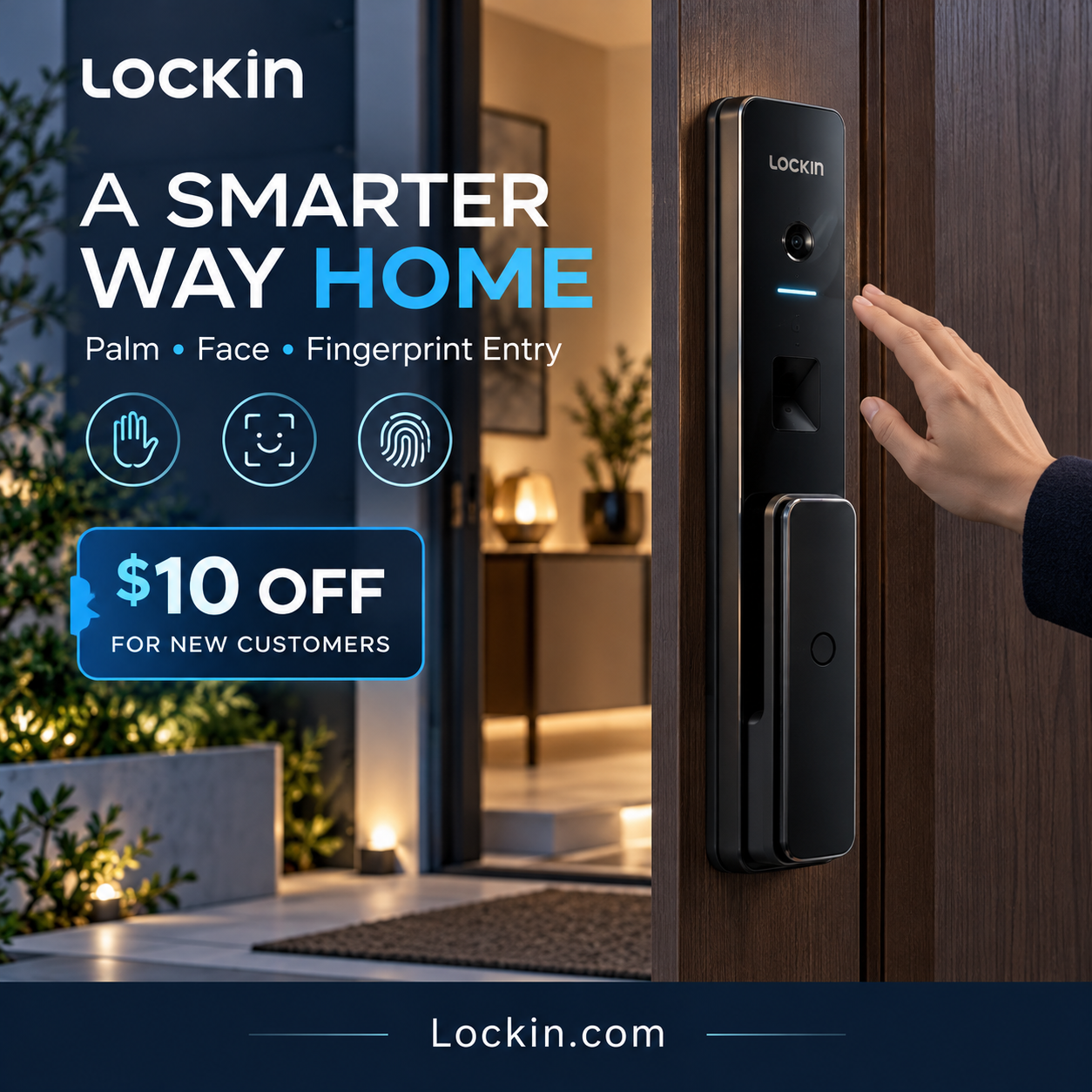
Lockin’s product range is organized around a practical question: what should a person be able to do at the door, and how should the lock fit into the routines of a household? The company’s website presents palm-vein recognition as a central feature, alongside models with fingerprint, face, PIN, app and mechanical-key access, as well as solar-assisted and video-equipped options. The lineup is available through Lockin, where the company groups products by features and everyday needs rather than presenting a single lock as the answer for every home.
That breadth makes Lockin more useful to understand as a smart-lock company than as the maker of one signature model. Its range includes locks focused on touch-free palm-vein entry, variants that add other unlocking methods, and products whose listed features include solar charging or video. Lockin also presents app and connected-home control as part of its broader offering. The company’s own site describes its technology and product history in promotional terms; the specific features below reflect the descriptions it provides for its models and services.
A lineup built around different ways to enter
Several Lockin models center on palm-vein recognition, which the company calls Venokey. The Veno Palm is described as a palm-vein recognition smart lock, with Lockin stating that it unlocks without contact and is intended to work with wet, oily, dusty or aging hands. The Veno Go is also a palm-vein smart lock. Its listing highlights Venokey recognition and identifies five unlocking methods, although the available page text does not enumerate all five for this model. Those descriptions indicate the company’s emphasis: recognition is meant to reduce reliance on a conventional key or a touch-based biometric interaction.
Other Veno products add different methods or features. Lockin lists the Veno Plus and Veno Pro as palm-vein recognition video smart locks. Their descriptions identify palm-vein recognition, fingerprint, PIN code, mechanical key and app control among the available unlocking methods. The Veno Pro is also offered in a version with a solar panel. These model names matter because the word “Veno” alone does not identify one fixed feature set: the listed products vary in whether they include video, solar equipment or particular access methods.
The site also features Veno Solar Finger and Veno Solar Face models, along with a Veno Solar Palm. Lockin describes these as ABX3 perovskite solar products and says that light helps reduce routine charging. The Solar Face description says solar charging activates below a stated battery level, while the Solar Finger and Solar Palm descriptions emphasize power from light. The available text does not provide a complete technical explanation of the solar system, so the most useful distinction for a shopper is the product category and the company’s stated goal of reducing the need for manual recharging.
Some models appear with door-lever configurations, including solar and palm-vein variants. This means the range is not only differentiated by recognition method or electronics; Lockin also lists configurations that pair a lock with a lever. The website names round-lever versions for some Solar Palm, Solar Face and Veno Go offerings. That information can help narrow a comparison, but it does not replace checking a specific product’s compatibility details. Lockin’s own installation guidance recommends checking door compatibility for the model before fitting it.
What the feature groups are designed to address
Lockin’s “Walk Up, Walk In” and “Keyless Entry” categories frame palm-vein recognition as a way to make arriving at a door less dependent on finding and using a key. Its family-use messaging similarly presents the locks as a shared household access point, intended to make coming and going simpler. These are the company’s descriptions of the intended experience, not guarantees about how a particular household will use a product. The practical distinction is that the lineup offers multiple forms of entry, so people comparing models can look at the access methods actually listed for each one.
For buyers who prefer more than one way to unlock a door, the Veno Plus and Veno Pro descriptions are relatively explicit: they list palm-vein recognition, fingerprint, PIN code, mechanical key and app control. The inclusion of a mechanical key gives those models a named non-digital method as well. Other listings may give a shorter feature summary, so the homepage alone is not a complete specification sheet. The model page and installation information are the appropriate places to confirm the precise functions of a chosen version.
Video is another point of differentiation. Lockin labels the Veno Plus and Veno Pro as video smart locks and promotes a wide doorstep view in its broader feature navigation, describing it as an 180-degree view. The site also presents Lockin AI as a way to support awareness at the doorstep. The available text does not explain the video system’s full capabilities or the specific functions of the AI, so it would be misleading to infer features beyond those descriptions. The supported takeaway is that Lockin’s range includes models positioned to combine door access with a view of the doorstep.
App control broadens the company’s concept of the lock beyond the physical mechanism. Lockin describes phone-based control in terms of locking, unlocking, seeing and responding. The website does not specify in the supplied text which of those functions are available on every model, or whether additional equipment is needed for particular uses. As a result, app control is best treated as a feature to verify at the individual-model level rather than an assumption that applies uniformly across the entire catalogue.
Solar models and the charging question
Lockin uses solar charging as a separate organizing idea within its range. Its ABX3 perovskite solar products are presented as using light to reduce routine charging, and the company’s general Solar Power category says sunlight can help power a lock and reduce manual recharging. This positions the solar models for people who want charging to require less regular attention. The site does not claim that sunlight removes every need for battery management, and the product descriptions should not be read as promising uninterrupted operation in every lighting condition.
The way the site describes individual solar models is not identical. Solar Finger and Solar Palm listings emphasize power from light, while Solar Face includes a note that charging activates below a battery threshold. Lockin also lists Veno Pro with a solar panel as a separate product configuration. Those differences make model-specific documentation important: the general idea of solar assistance is shared, but the precise arrangement and behavior should be checked against the particular lock and its instructions.
For someone comparing models, solar is therefore one decision point rather than a substitute for comparing access and monitoring features. A Solar Finger or Solar Face model is identified by its recognition category as well as solar charging; a Veno Pro with solar is also listed as a video lock with multiple unlocking methods. Lockin’s product range combines features in different ways, so a buyer can begin with the need that matters most—such as palm-vein entry, video, or reduced routine charging—and then check which specific model includes it.
Connected-home options and installation information
Lockin’s homepage displays Apple Home, Amazon Alexa, Google Home, Samsung SmartThings and Matter in a section about connecting a home with Lockin. It also includes the phrase “Built on Thread.” This signals that the company presents connected-home compatibility as part of its offer, but the supplied text does not establish that every listed lock works with every platform or that all integrations are available in the same way. Anyone whose decision depends on a particular ecosystem should confirm compatibility for the exact model and setup rather than relying on the brand-level list.
The company also points prospective owners to a step-by-step installation guide. Its description says the process covers checking door compatibility and fitting and setting up the lock. That is a useful detail because installation begins with the door itself, not merely with the desired app features. The supplied material does not specify a universal fit, the tools required or the installation time, so those questions belong with the instructions for the selected product. Lockin’s website also provides an order-tracking area and lists a support email address, though the source text does not describe service response times or support policies.
Lockin organizes some of its shopping navigation by need rather than model name. Categories include family use, keyless entry, doorstep view, AI, app control, confidence and installation. These labels help explain the company’s intended use cases, but they are not a substitute for product specifications. In particular, a category such as family use describes the brand’s positioning; it does not establish that every model has identical access management or household-sharing functions. Comparing the actual listed methods and features is the more reliable way to understand differences across the catalogue.
How Lockin describes its scale
The company’s homepage supplies several figures about its reach and organization: it says Lockin has more than 42 million global family users, has sold more than 12 million products worldwide, is available in 50 countries, and has 51 percent of its employees in research and development. It also describes a decade of innovation. These are figures and characterizations presented by Lockin itself, rather than independently verified findings in the supplied source material. They provide context for how the brand portrays its business, but they do not by themselves establish the performance of an individual lock.
That distinction is worth keeping in view throughout a comparison. Broad statements about leadership, security or dependability appear in the company’s own marketing, while the most actionable information is the feature list attached to a named model. Lockin’s strongest, clearest product story in the supplied material is the variety of access approaches it puts under one brand: palm-vein recognition, models with multiple unlocking methods, solar-assisted options, and video-equipped locks. Its connected-home and installation information adds context, but those details still need to be checked at the model level.
For readers considering Lockin, the most grounded way to navigate the range is to start with the door task rather than the promotional headline. Decide whether touch-free palm-vein recognition is the priority, whether a fingerprint, PIN or mechanical-key option is also wanted, whether video matters, and whether solar assistance is relevant. Then compare the precise model listing and compatibility guidance. Lockin’s catalogue is presented as a set of combinations, not a single uniform product, and that is the central fact to carry into any closer evaluation.
Sponsored by Gabal Global Group, with publishing tools from CheapPlugins.