


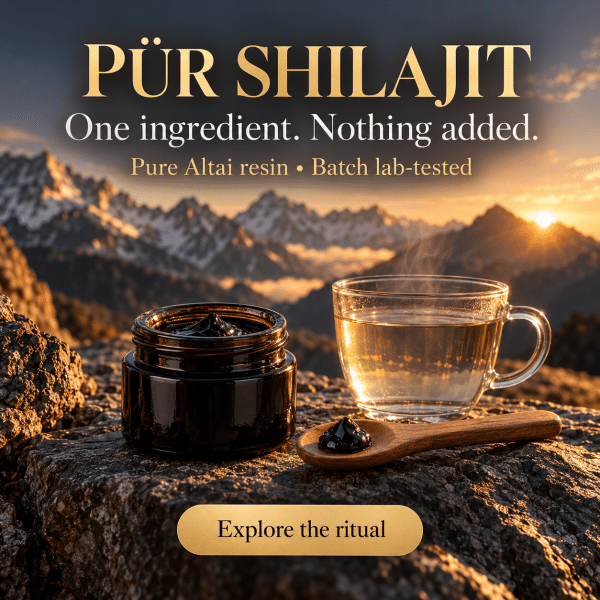
Pür Shilajit presents itself as a family-owned business built around a specific supply chain: shilajit gathered in the Altai Mountains, prepared as a single-ingredient product, and sold in several formats for different routines. Its website places emphasis not just on what it sells, but on who handles the material and how the company says it checks each batch. The profile that emerges is of a small company making traceability and family involvement central to its account of the business. Pur Shilajit is the seller; the source pages also describe the mountain-harvesting family behind its supply.
That combination gives the company a useful angle beyond a simple catalog of resin, tablets, and capsules. Pür Shilajit connects its product range to its account of sourcing, preparation, and testing, while presenting the formats as different ways to fit the same source material into a daily practice. Its statements about quality and wellness are the company’s own claims, so it is helpful to distinguish those descriptions from independently established conclusions.
A company story rooted in a supplier relationship
In its account of the company’s beginnings, founder Jason Reese says that his earlier work in the natural-health industry left him concerned about product purity and how some products were represented. He writes that a friend introduced him to a family in the Altai Mountains whose members had harvested shilajit for seven generations. Pür Shilajit says it began operating in 2019, building its business around that relationship and a commitment to sell what it describes as authentic, uncut shilajit.
The company’s account makes the relationship between the harvesting family and the business a central part of its identity. Its founder says that only the harvesting family and his own family handle the shilajit before it reaches customers. This is a description supplied by the company, rather than a third-party audit of its supply chain, but it explains why Pür Shilajit repeatedly emphasizes direct sourcing and limited handling in its own materials.
The family-run element is also described in practical, personal terms. Reese says he handles social-media messages, his sister Heather responds to emails, and his wife Natalie packs orders from a home office. He also describes their daughter as being involved in a lighthearted “sticker” role. Rather than presenting the company as a large wellness corporation, the page frames it as a household business in which the family has direct contact with customers and participates in day-to-day operations.
Reese also says the company has declined acquisition offers and has no investors. Those statements are part of the founder’s explanation for maintaining independence; the pages do not give further details about the offers. The site connects that independence to its view that the business can stay focused on its standards. Readers can understand this as the company’s stated rationale, not as proof that a particular ownership structure guarantees product quality.
How Pür Shilajit describes its sourcing and preparation
The site identifies the Altai Mountains as the source of its shilajit and describes the material as wild-harvested. One page says the harvesting team travels as far as roads permit and continues on foot, gathering pieces by hand. It also says the material is not blasted from the mountain. This account presents harvesting as a labor-intensive process and links limited availability to the time and effort involved. The source pages do not provide a harvest calendar or a detailed account of the environmental impact, so those aspects should not be inferred from the description.
Preparation is another prominent part of the company’s explanation. Pür Shilajit says its resin is sun-dried for more than 70 days. The company describes the resulting material as one ingredient, without fillers, preservatives, or other additives. Its collections page uses the same preparation claim to describe its flagship resin, while the tablet description says the tablets are pressed from pure resin without binders or fillers. The company’s capsule listing describes a vegan capsule format, but the supplied pages do not specify further capsule ingredients or manufacturing details.
For customers, these details help explain how the company distinguishes its offerings: the source material is presented as the same Altai shilajit, while the forms and methods of use differ. Resin is described as the traditional, raw form, to be scooped, dissolved, and consumed as a drink. Tablets are described as pre-measured and suitable for dissolving or swallowing. Capsules are presented as a simple, no-preparation option. The site also lists an accessory collection, including a spoon, as a tool for the ritual.
These are product-use descriptions, not evidence that one format works better than another. The pages do not provide comparative studies of the forms or detailed instructions for every item. Someone choosing among them can use the descriptions to understand the practical differences the seller highlights—preparation, measuring, and portability—without treating those distinctions as claims about different health effects.
Batch testing and the company’s quality claims
Pür Shilajit says every batch is tested and traceable. Its pages name Eurofins as a testing laboratory, and the About page says batches are tested by independent laboratories accredited to ISO 17025 for heavy metals and microbial concerns. The company also says it publishes laboratory reports publicly. These are meaningful details in the company’s account of its quality process, but the supplied material does not include the reports themselves, test results, or a batch-specific document to examine here.
The About page further says the product meets California Proposition 65 guidelines. That, too, is a claim made by the company on its website. The source text does not explain the basis for that statement or identify a particular report supporting it. A careful reader seeking information about a specific batch would need to consult the relevant report that the company says it publishes, rather than treating a general site statement as a substitute for batch-level documentation.
“One ingredient” is another organizing idea across the site. Pür Shilajit uses it to distinguish the resin from products that might contain added materials, and applies a similar description to the tablets. The company’s collection page also describes the material as containing fulvic acid, trace minerals, and amino acids. Those composition details and purity statements are presented in promotional copy; the source pages supplied here do not include a full independent analysis that would allow a reader to verify the figures or compare them with other products.
The company’s main page associates shilajit with support for energy, focus, and cognitive function, and describes it as naturally rich in fulvic acid and trace minerals. It also includes the standard notice that the statements have not been evaluated by the Food and Drug Administration and that the product is not intended to diagnose, treat, cure, or prevent disease. That caveat matters: the website’s wellness language should be understood as the seller’s marketing, not as a promise of a medical outcome or a substitute for professional advice.
Formats, bundles, and the intended routine
The product range is designed around a repeated-use routine. The site’s language suggests taking shilajit in the morning, but the specific choice of format is left to the customer. Resin offers a scoop-and-dissolve approach; tablets provide a measured solid form that can be dissolved or swallowed; and capsules are offered for people who want to avoid taste and preparation. The website also refers to subscriptions for some products, although the supplied material does not set out the full subscription terms.
Pür Shilajit offers ready-made bundles containing different combinations of resin and tablets, including quantities it labels as 30-day, 60-day, or annual supplies. It also provides a build-your-own option, inviting customers to mix two or more products. The page advertises bundle discounts and a gift box at a stated order threshold during its seasonal promotion. Those offers are tied to the promotional material provided and may change; they are not permanent features of the company’s product range.
The site’s gift finder is another way the company organizes its catalog. It asks about the intended recipient, their activities or household routine, and the amount of product needed, then suggests combinations from the listed formats. This tool reflects the company’s effort to make the product range navigable, especially for gifting. It does not replace detailed product information, and the recommendations should be understood as shopping suggestions rather than individualized health guidance.
Elsewhere, the site lists a 90-day money-back guarantee, worldwide shipping, and customer support handled by the founder or family members. It also describes checkout options and says orders are dispatched from the United States. The source pages do not provide the full guarantee terms, delivery timelines, or eligibility rules, so customers would need to review the current terms on the company’s site before relying on those details.
What the company’s identity adds to the catalog
Across its pages, Pür Shilajit asks customers to consider more than a format or a jar size. It foregrounds a source in the Altai Mountains, a multigenerational harvesting relationship, sun-drying, testing, and family participation in the business. Those elements form a coherent account of how the company wants to be understood: as a small, independent seller that ties its product standards to identifiable people and processes.
The most useful way to assess that account is to separate its documented descriptions from its broader assurances. The site clearly identifies the formats it sells and describes how it intends them to be used. It also states that its batches are tested and traceable, and that reports are published. At the same time, claims about purity, quality, composition, and wellness remain claims made by the seller unless supported by the relevant report or other evidence. That distinction lets readers take the company’s sourcing story seriously without treating its promotional language as independent verification.
For someone exploring Pür Shilajit, the central choice is therefore both practical and informational: which format suits a routine, and what level of documentation the buyer wants to consult about the source and testing. The company provides a clear framework for that decision, with resin, tablets, and capsules positioned as different forms of the same source. Its defining story is the connection it draws between mountain harvesting and a family-run operation—and the importance it says it places on maintaining that connection from batch to customer.
Get all details about Pur Shilajit
Sponsored by Gabal Global Group, with publishing tools from CheapPlugins.