


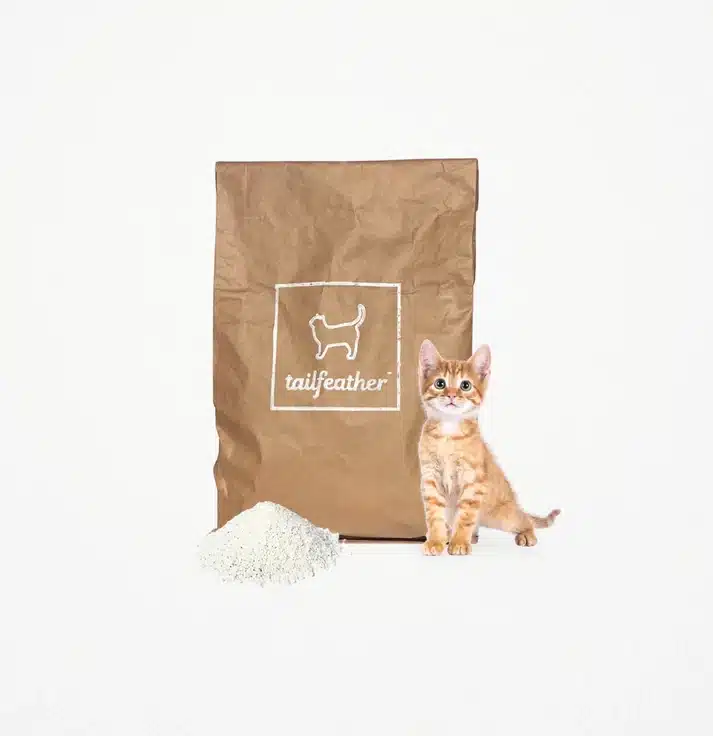
Tailfeather is a plant-based cat litter built around a specific alternative to conventional clay- and silica-based formulas: coconut coir combined with cassava. Tailfeather presents the product as a lightweight, unscented litter that clumps for scooping, with packaging and a subscription option intended to simplify regular replenishment. The brand’s stated design goals include serving cats, their households, and the environment; those are the company’s aims, while the product details below describe what its pages say the litter contains and how it is intended to be used. Tailfeathercats
For someone comparing litter materials, the most useful starting point is the ingredient explanation. Tailfeather identifies coconut coir and cassava as its ingredients, describing cassava as the clumping agent and coir as a renewable byproduct of processing coconuts for other uses. The product page says the litter is biodegradable, unscented, lightweight, low in dust and tracking, and compatible with automatic litter boxes. Those are the sponsor’s product claims, rather than independent test findings.
A litter designed around coconut coir and cassava
Tailfeather’s material choice is central to how the company distinguishes its litter. The site says coconut coir is leftover from traditional processing for consumable products, and that using it requires no additional farming or mining. The pages also describe the coir as naturally biodegradable. Cassava, also called yuca, is identified as the clumping ingredient in the formula. Together, these materials form the product the company describes as a plant-based alternative to litter made with mined clay or silica.
The brand connects the choice of coir to both sourcing and the experience of using the litter. Tailfeather says the material feels natural to cats and notes that its dark color is intended to resemble soil cats might use outdoors. The site does not provide a technical comparison of the formula with other litter materials, nor does it quantify the product’s environmental effects. Its stated rationale is that using coconut coir avoids additional farming or mining for that ingredient and can reduce reliance on mined materials used in traditional litters.
That distinction matters when reading sustainability language. Tailfeather describes the litter as sustainable and biodegradable, and says its approach reduces the impact associated with mining for traditional products. The pages do not give a lifecycle assessment, decomposition timetable, or details about disposal conditions. Readers can therefore understand the brand’s material rationale without assuming that the site documents every environmental outcome. The specific, supported points are the named ingredients, the claimed coir sourcing, and the company’s aim to avoid clay and silica.
Clumping, odor control, and a scent-free approach
In everyday use, the product is presented as a clumping litter. Tailfeather says its clumps are strong and easy to scoop, and its product description adds that they are intended to hold together without sticking to the box or falling apart. The company frames this as a way to make cleaning faster and leave the litter box cleaner. It recommends scooping daily for the freshest results. These descriptions establish what the brand intends the formula to do; they should not be read as a guarantee that every household will see identical results.
Tailfeather also emphasizes odor management without added artificial fragrance. Its pages describe the product as unscented and claim natural odor control, including “excellent” odor control. For households seeking a litter without artificial scents, that is a clear feature of the product as described. The site does not name a separate deodorizing ingredient or provide measurements for odor absorption, so it is more accurate to describe the claim in the company’s own terms than to infer a particular mechanism.
The no-added-scent positioning is paired with the brand’s claims about clumping and freshness. Tailfeather says the litter absorbs odors and stays fresh, and its product page recommends daily scooping. The company’s customer-facing copy also says cats prefer the formula, but the source material does not provide independent research supporting that preference. A practical way to assess the product for a particular cat is to take its stated formula and instructions into account, rather than treating promotional statements as universal results.
Weight, dust, and tracking are part of the product brief
The brand describes Tailfeather as lighter than traditional cat litter, and says the reduced weight makes it easier to carry, pour, and scoop. Its package contains two bags totaling 13 pounds. Tailfeather estimates that this amount will last about eight weeks for one cat using one litter box, with enough for a full refresh during that period. That estimate is specific to the company’s stated one-cat, one-box use case; the pages do not give a separate duration for larger households or different box routines.
Tailfeather also characterizes the particles as low-tracking and low-dust, with another product description calling the litter very low dust and gentle on the lungs of cats and people. The company says the particles are less likely to stick to cats’ feet. Those details speak to household handling and cleanliness, but the site does not publish particle measurements or explain a testing method. The most careful summary is that low dust and low tracking are features the brand claims for its formula, not numerical specifications supplied in the available product information.
For buyers comparing products, weight, dust, and tracking are distinct considerations. A lighter package can be easier to move, while low-tracking and low-dust descriptions address what may happen around the box and during pouring. Tailfeather makes claims in all three areas, but its pages do not give comparative data against named competing litters. The product’s stated benefits can help identify what the company is trying to prioritize, while leaving room for individual households to judge whether those qualities meet their needs.
Package contents and the company’s use instructions
The package is described as two bags of litter, 13 pounds in total. Tailfeather’s FAQ says to use one full bag for each litter box and to replace it with the second bag after about four weeks. The product page says the package comfortably lasts eight weeks for one cat, with enough for a full refresh in between. These directions appear to describe one box and one cat as the reference setup, so the stated duration should not automatically be applied to a home with multiple cats or boxes.
The brand recommends daily scooping. Its instructions are concise: remove waste regularly, and use the second bag for a full replacement at around the four-week point. The source pages do not specify a transition schedule for switching from another litter, a precise depth for filling the box, or a disposal method for used litter. It is best not to add assumptions on those points. Buyers who need guidance beyond the published instructions can seek clarification from the company.
Tailfeather says the litter is compatible with automatic litter boxes. That is a useful product detail for households considering mechanized cleaning, although the source material does not name specific models or describe settings. Compatibility is therefore a general claim from the brand, not confirmation for every automatic box. If a particular device’s requirements are important, checking those requirements alongside Tailfeather’s product information would be prudent.
Packaging and ordering arrangements
The company describes its packaging as fully recyclable and plastic-free. This is separate from the litter’s ingredient and biodegradability claims: the site presents the packaging as recyclable and plastic-free, and the litter itself as made from plant-based materials and biodegradable. The available pages do not spell out local recycling rules or disposal instructions, which can vary by location. The claims are useful for understanding the intended packaging format, but do not establish how a particular municipality handles it.
Tailfeather offers a cat litter subscription and says customers can adjust the frequency or pause it online at any time. The brand presents the subscription as a way to keep a fresh supply available, while leaving the timing adjustable. The pages do not provide a specific delivery schedule in the available material, so the useful confirmed point is flexibility to change or pause the subscription, rather than any assumed cadence.
The product page also states that new customers can return the product within 30 days for a full refund if they are not satisfied. Its FAQ instructs customers to contact the company at hello@tailfeathercats.com within that period to arrange a return. This is a concrete part of the company’s stated offer, though customers should consult the current terms on the site for any applicable details before ordering.
Who may want to examine the details
Tailfeather’s product information is most relevant to cat owners looking for a litter with named plant-based ingredients, no artificial scent, and a clumping format. Its stated use of coconut coir and cassava gives shoppers more to evaluate than a broad label such as “natural.” The two-bag, 13-pound package, one-box usage estimate, daily scooping recommendation, and automatic-box compatibility claim make the product’s intended routine easier to understand.
At the same time, the pages leave some questions unanswered. They do not offer comparative performance measurements, detailed testing methods for dust or odor control, a full environmental assessment, or model-by-model guidance for automatic boxes. Nor do they explain disposal in different local systems. Those gaps do not erase the product facts provided; they mark the boundary between the company’s published description and information a buyer may still want to verify.
In short, Tailfeather is a specific litter formula rather than a broad catalog of unrelated cat products. Its distinguishing story is the use of coir and cassava, supported by claims about clumping, odor control without artificial scents, light weight, low dust and tracking, and recyclable plastic-free packaging. The company also gives a defined package quantity and routine for a one-cat household, alongside an adjustable subscription and a stated 30-day refund offer for new customers. Read together, these details offer a practical picture of what Tailfeather sells and how it expects the product to fit into a household’s litter-box routine, while leaving performance and environmental outcomes appropriately framed as the brand’s claims.
Get all details about Tailfeathercats
Sponsored by Gabal Global Group, with publishing tools from CheapPlugins.