


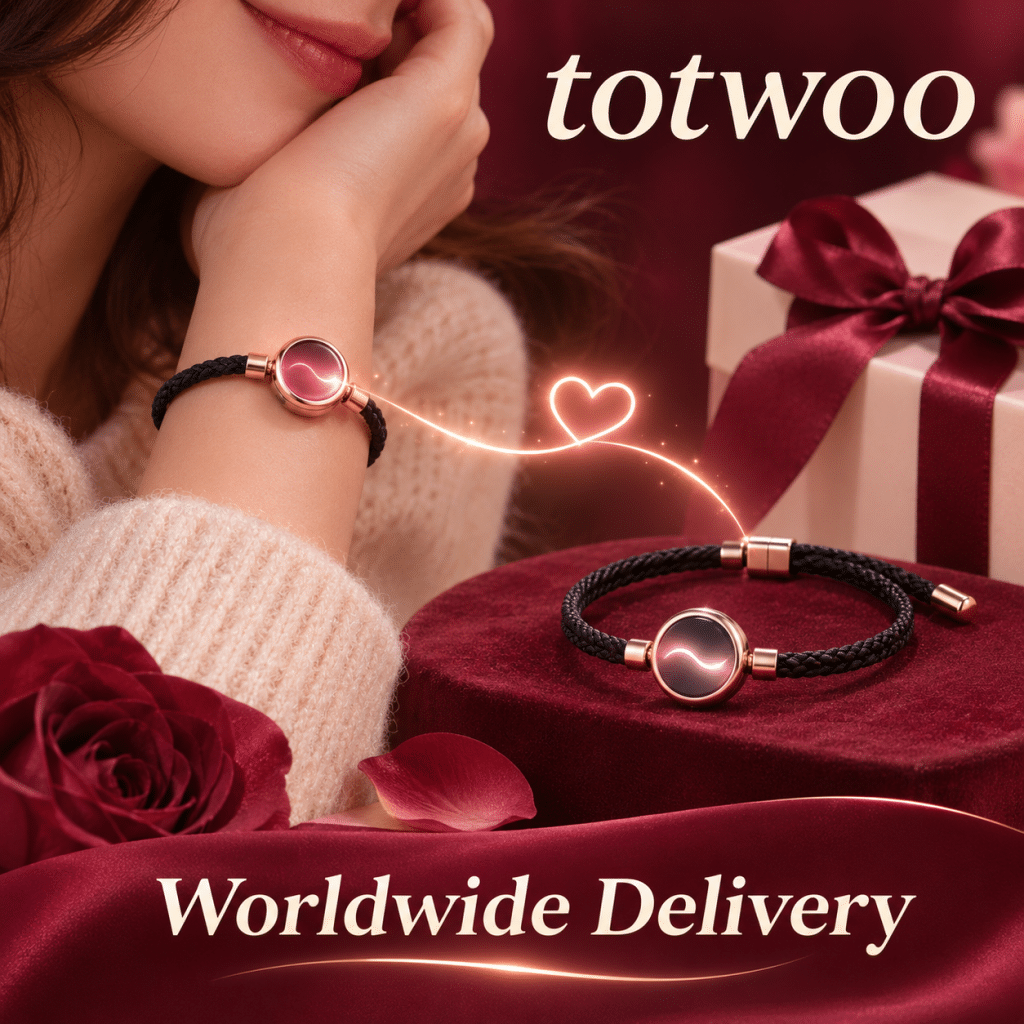
Totwoo presents jewelry as a way to send small signals between people who may not be in the same place. Its connected bracelets and necklaces pair with the Totwoo app, allowing one person to touch their jewelry and prompt a light and vibration on a loved one’s piece. That simple exchange is the central idea behind Totwoo: make a familiar item of jewelry part of an everyday, two-person connection.
The company’s range is broader than a single bracelet design. Its site groups products into touch bracelets, touch necklaces, single pieces that can be paired with another item, and accessories such as charms. Collections include Sun & Moon, Mountain & Sea, Soulmate, Morse Love and Candy. Across those choices, Totwoo’s emphasis is on combining a wearable style with a set of app-based signals and reminders, rather than treating connected jewelry as only a notification device.
A touch becomes a signal
The basic interaction is described in three steps on Totwoo’s site: each wearer connects a bracelet to the app, the two people link as a pair, and a touch on one bracelet sends a signal to the other. The receiving jewelry lights up and vibrates. Totwoo says this works across distance, and its product pages frame the effect as a way to share a moment without needing to start a conventional conversation.
That distinction helps explain the role the jewelry is meant to play. A light or vibration is not presented as a detailed message. It is a brief cue from one person to another: a reminder that someone is thinking of them, or a small invitation to respond when convenient. The usefulness of that kind of signal depends on the people using it and the meaning they attach to it; the company’s pages describe the function, but do not prescribe what every touch must mean.
Totwoo also describes options for making that cue more personal. Users can design light patterns and vibrations, creating what the company calls a private language between two people. In practice, that positions the signal as something a pair can shape for themselves rather than a fixed alert with one universal interpretation. The source pages do not specify the full range of pattern controls, so it is safest to understand this as an offered customization feature rather than assume particular settings or capabilities.
Other features extend the idea beyond an on-demand touch. Totwoo lists call alerts, which let a wearer feel a loved one’s call through the jewelry, and anniversary reminders delivered through light and vibration. It also describes love letters that can be revealed in the app by touching the jewelry. These features put different kinds of communication under one umbrella: a spontaneous signal, a prompt tied to an event, and a note saved for someone to discover.
More than one look for a shared connection
Totwoo’s product assortment suggests that matching does not have to mean wearing identical pieces. Many paired bracelets are offered in combinations of materials, colors and chain styles. The Sun & Moon designs, for example, appear with Milan rope, snake chain, Figaro chain, braided cord or beads, and some sets combine two different styles. The Mountain & Sea and Soulmate collections also have distinct visual themes and multiple configurations.
That variety matters to the company’s concept because the connected function is shared while the visible design can differ. A pair might choose matching pieces, or select bracelets that reflect each wearer’s preferences. The site also offers single smart jewelry intended to be paired with another piece, rather than requiring every shopper to choose a pre-matched set. It lists individual bracelets and necklaces in several styles, giving the idea room to accommodate people who want to assemble a pair themselves.
The range reaches beyond romantic couples. Totwoo organizes gift suggestions for friends and for mothers and daughters, alongside gifts for couples. Its product descriptions also identify some styles as suitable for best friends or family members. The common thread is not a particular relationship label but the possibility of two people sharing a connected signal. The company’s framing is intentionally broad, though the actual meaning of the exchange remains something the wearers decide.
For shoppers drawn to symbolic details, Totwoo lists charms, initials and birthstones as ways to personalize pieces. The site describes these as additions that can help make a piece more individual. Some product names also use recognizable motifs, such as Sun & Moon or Morse Love. These details add another layer to the gift: a design or symbol can carry meaning even when the connected feature is not being used.
The Smart Locket takes a different approach
Alongside its touch jewelry, Totwoo promotes a Smart Locket as a way to bring photos and moving memories into a wearable keepsake. The company says the locket can include a photo slideshow, a short video or an AI moving memory. Its description focuses less on a brief signal between two pieces and more on carrying visual material associated with someone or an important moment.
This makes the Smart Locket a distinct part of Totwoo’s assortment rather than simply another version of a touch bracelet. The bracelets and necklaces emphasize a signal sent from one wearer to another; the locket is presented as a way to keep and revisit selected images or video. The source material does not explain technical requirements, storage limits or the precise setup process for the locket, so those details should not be inferred from the promotional description alone.
The two approaches nevertheless sit within the same larger idea: jewelry can be used to hold or express a connection. One mode is interactive and brief, such as a touch that prompts light and vibration. Another is more reflective, centered on a visual memory. Customers comparing Totwoo’s offerings can therefore consider not just which piece looks right, but what kind of role they want the object to have in a relationship.
How to think about the range
A practical starting point is to decide whether the main interest is the shared touch function, the look of the jewelry, or a combination of both. Someone drawn to a simple paired signal may begin with the touch-bracelet collections. A person seeking a necklace form can explore the touch-necklace options. Those who want to choose pieces separately can look at the single-jewelry category, while the Smart Locket serves a different purpose centered on images and moving memories.
Next, the design choices can narrow the field. Totwoo’s catalog includes rope, chain, silicone and bead styles, along with different color pairings and themed collections. The website names options such as black and brown Milan rope, snake chain, Cuban and paperclip chains, silicone with a Morse-code LOVE motif, and natural-stone bead designs. These are concrete examples of how the collection varies; they do not establish that every style is available in every configuration.
It is also worth considering whether a pair wants the same appearance or simply the same connected function. Totwoo sells matching sets but also displays combinations where each bracelet has a different finish or form. Its single pieces make another route possible. The site’s “pair your own” framing indicates that the company expects some shoppers to build a combination around individual taste rather than select only from a fixed matched design.
For gifting, the company’s site groups products by relationship and occasion, and it offers gift packaging and gift cards. Those tools support different ways of choosing: a specific piece for someone whose style is known, or a gift card when the recipient should make the final selection. Totwoo also describes personal additions such as initials, birthstones and charms. These options are presented as ways to add meaning, not as requirements for using the connected features.
A company organized around connection
Totwoo’s pages describe the brand as a meeting point between jewelry and smart technology. Its range supports that positioning through several kinds of product: paired touch bracelets, touch necklaces, individual pieces, decorative accessories and the Smart Locket. The shared theme is that an object worn or carried can help people express closeness, whether through a live signal, a reminder, a saved note or a visual memory.
The company also makes broad claims about the size and activity of its user community, including a statement that more than one million users trust the brand and that 1.5 million flashes are sent daily. Those figures appear in Totwoo’s own promotional material and should be understood as company-reported claims, not independent measurements. The site includes customer stories and reviews as well, but individual accounts are personal experiences and do not establish what every wearer will experience.
Ultimately, Totwoo is not describing connected jewelry as a substitute for conversation or as a solution to distance. Its products are built around smaller gestures that can sit alongside ordinary communication: a light, a vibration, an anniversary prompt, a love note, or an image kept close. For people interested in wearable objects that carry a shared meaning, the company’s collection offers several ways to explore that idea, with the exact choice shaped by the relationship, the preferred style and the kind of signal the wearers want to share.
Sponsored by Gabal Global Group, with publishing tools from CheapPlugins.