


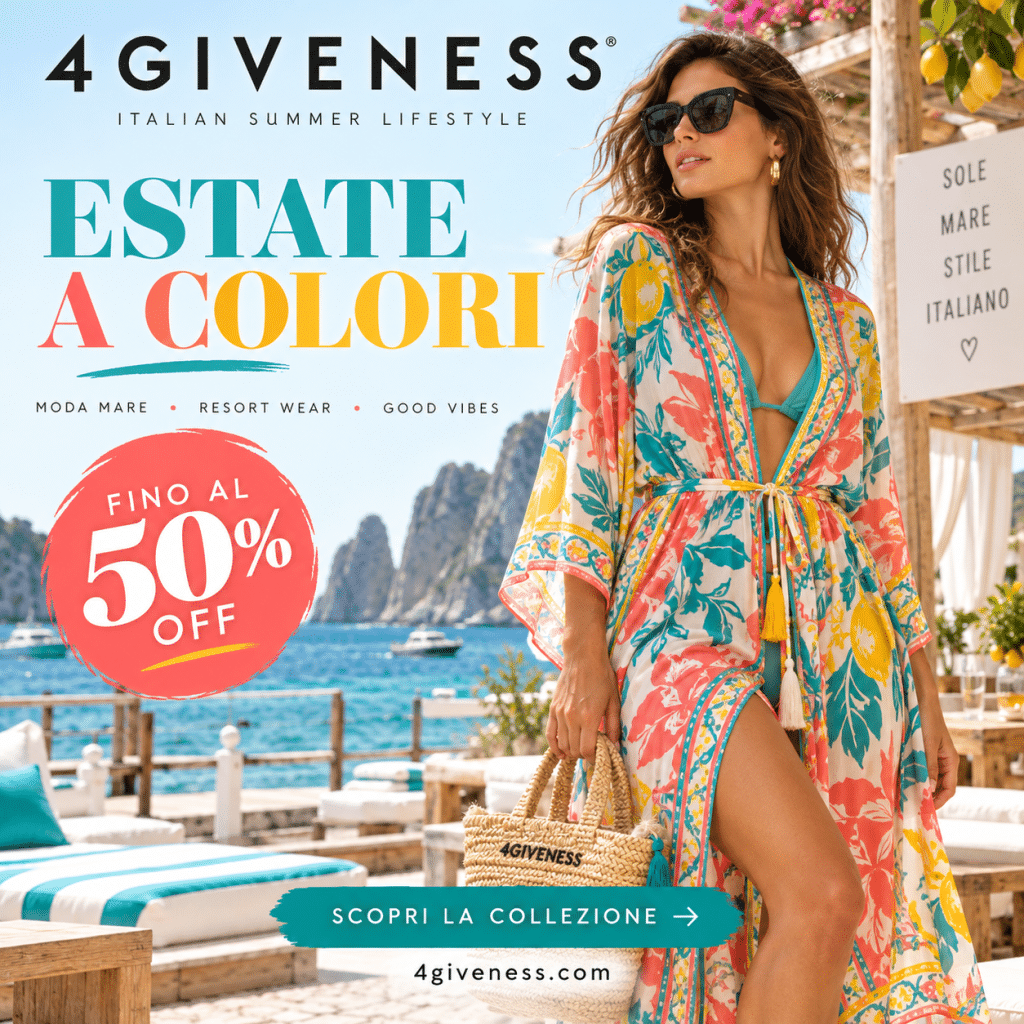
4Giveness 4giveness is an Italian swimwear and clothing brand whose own account traces its beginnings to 2015. The company says two creative founders with a shared vision established the business, shaping it around distinctive, sensual swimwear made by women for women. Its online store now presents swimwear alongside cover-ups, clothing, accessories and ranges for men and children. Rather than focusing on one signature garment, the brand’s identity comes through a broad assortment organized by garment type and by named collection themes.
The company is identified on the site as GAMS Srl, with an address in Barletta, in the province of Barletta-Andria-Trani, Puglia. The store’s navigation gives a practical sense of how 4Giveness frames its offer: shoppers can browse by collection, by women’s swimwear shape, by beachwear category, or by audience. That structure makes the site useful to consider as both a swimwear label and a wider seasonal clothing business. The pages supplied do not describe a single flagship product; they show a catalog of styles and categories instead.
A swimwear range organized by silhouette
Women’s swimwear is divided into several recognizable forms. The menu includes triangle bikinis, balconette bikinis, bandeau and other bikini tops, and one-piece swimsuits, including monokinis. These distinctions are more than a simple division between two-piece and one-piece suits: they give visitors a way to navigate the collection by the shape named in the product category. The catalog pages also show variations within those groupings, with listings for triangle styles, bandeau styles and balconette designs, as well as one-piece suits.
That range is visible in the product names displayed on the SS26 women’s page. Examples include a Kenya triangle bikini, a Kenya one-piece, a Congo trikini and a Congo bikini top with bottoms. The listings also include a style described as a triangle and bottoms in a Marilyn Kenya design. These names establish the variety of forms and collection labels present in the catalog, without implying that every cut is offered in every print or that any particular fit suits every wearer. The supplied pages do not provide detailed sizing or construction information.
For a shopper comparing shapes, the site’s categories offer a starting point rather than a substitute for garment-specific details. A triangle bikini, a balconette style, a bandeau top and a one-piece are clearly treated as separate browsing destinations. The broader menu also includes a free-beach section, with tops and bottoms listed separately. In editorial terms, this arrangement highlights how the brand distributes attention across distinct swimwear formats, instead of presenting beachwear as a single undifferentiated category.
Print names give the collections their framework
Alongside garment shape, 4Giveness uses named collection themes to organize its seasonal assortment. The main navigation lists Preppy, Resort, Mexican, Nature, African and Cromatic. Those labels act as collection signposts on the store; the source pages do not explain their inspiration or define a formal design philosophy behind each one. The SS26 catalog pages show how collection naming and garment categories work together, with product names combining a cut or clothing type with a theme such as Kenya, Congo or Ethiopia.
The product names provide a more concrete view of the range’s visual vocabulary. The homepage and collection listings include patch animalier pieces, denim Mexican swimwear, a pastel cashmere-pattern bikini, and styles named Leo Touch. Other listed garments carry names such as Congo, Kenya and Ethiopia. These titles point to different print or collection identifiers, but the pages do not specify textile composition, print technique or the stories behind those names. What can be said is that the catalog uses print and theme labels consistently enough to help distinguish groups of products.
Some listings show the same theme across several garment types. On the SS26 women’s page, for instance, Kenya appears with triangle bikinis, a one-piece, a long skirt and a cropped shirt. Congo appears across swimwear as well as dresses, trousers, an oversized shirt and a short kimono. This cross-category presence suggests a catalog designed to let a shopper browse a theme beyond swimwear alone. It does not establish that every item is intended to be worn as a matching set, but the site does place related product names within the same seasonal assortment.
Beachwear extends beyond the swimsuit
4Giveness groups a substantial set of non-swim pieces under beachwear and free-beach categories. The navigation names tops, bottoms, shirts, trousers and shorts, pareos, skirts, short dresses and long dresses, alongside bags, pouches, towels and sandals. This breadth gives the brand’s store a wardrobe-oriented structure: the swimsuit is one part of a menu that also includes garments and accessories associated with beach settings. The pages list categories, rather than describing how pieces should be combined or prescribing particular occasions for wearing them.
The collection examples reinforce that breadth. The SS26 women’s listing includes a long skirt with a belt in the Kenya theme and a cropped shirt in the same named group. Congo is represented by a short dress, long dress, trousers, oversized shirt and short kimono. The home page also displays dresses, a long skirt and a neck-tie jumpsuit among its products. These examples show that 4Giveness’s seasonal assortment reaches beyond swim separates and one-pieces into several forms of ready-to-wear clothing.
Accessories are part of the store’s navigation too, with separate destinations for bags, pouches, towels and sandals. The supplied pages do not provide descriptions of their materials, dimensions or design details, so those categories are best understood as evidence of the catalog’s scope rather than a basis for specific product claims. The same care applies to the site’s broad labels such as “Summer Mood” and “Most Loved”: they appear as browsing or promotional headings, not as detailed explanations of the products beneath them.
Other audiences and the men’s collection
Although the company describes its origins through women’s swimwear, the website also includes sections for men and children. The children’s navigation separates girls, boys and babies. The men’s section is presented as a distinct collection, and its own description says that the line brings together contemporary style, comfort and elegance, with essential lines, considered details and versatile designs. These are the brand’s stated characterizations; the supplied pages do not offer independent evidence about fabric performance or fit.
Men’s product listings include short swim shorts in a range of named patterns, such as flower, daisies, orchids, crab, dolphins, palms, Hawaii, Capri and lemon. Solid or less motif-led options are also represented by names such as essential and must-have. The catalog pairs these shorts with printed jersey T-shirts, including listings named Club, Guest Beach, Cocktail Club, Baci from Capri and Capri. The examples make clear that the men’s range extends from swim shorts into casual tops, while leaving the precise materials and garment specifications to individual product information.
How the online store presents the brand
The supplied store pages feature filters and sorting options, including relevance, best sellers, alphabetical order, price order and date order. The SS26 pages show a catalog of 310 products overall and 257 in the women’s section at the time represented by the source text. Those figures are page-specific snapshots, not a guarantee of a fixed or permanent assortment. The presence of filters and separate category pages indicates that the online store is designed to let visitors browse a relatively large seasonal selection in more than one way.
The site also advertises installment payment, free shipping for orders above €59, fast shipping and secure payments. These are statements presented by the retailer; the supplied material does not include the detailed terms, delivery areas, payment-provider information or timing behind them. The footer provides links to buying guidance, sales conditions, payment information, shipping, returns and refunds, along with a newsletter invitation. For practical details, those dedicated sections are more relevant than the brief promotional statements on the page.
4Giveness therefore comes across in its own store as a catalog-led fashion brand with swimwear at its center and a wider summer assortment around it. Its stated history begins in 2015, while its current site structure emphasizes multiple bikini and one-piece shapes, named print groups, beach cover-ups and ready-to-wear clothing. Men’s and children’s categories broaden the audience beyond the women’s swimwear identity described in the brand’s origin story. The most useful way to understand the label from these pages is through that combination of shape-based browsing, collection names and an expanding mix of seasonal clothing—not through a single product or unsupported claims about how its garments perform.
Get all details about 4giveness
Sponsored by Gabal Global Group, with publishing tools from CheapPlugins.