


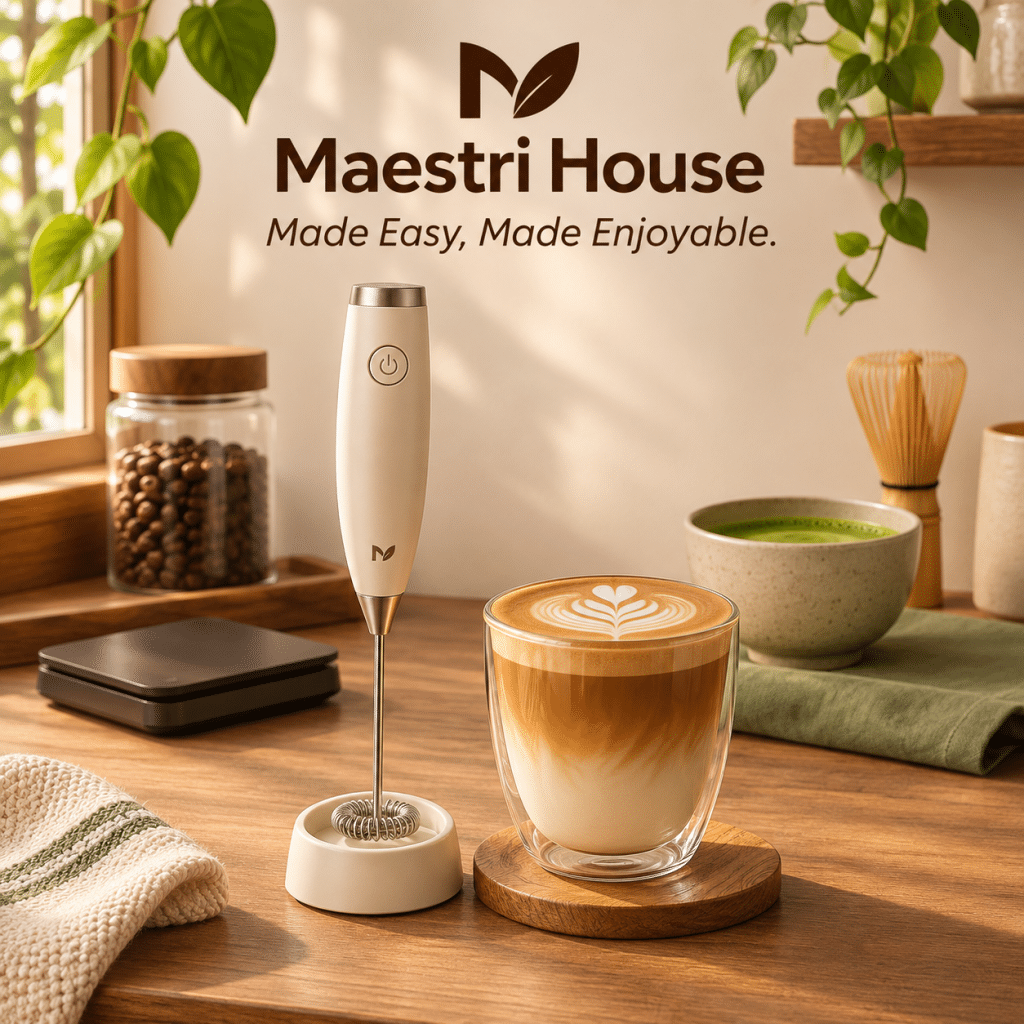
Maestri House organizes its kitchen products around the repeated steps that shape a drink at home: frothing milk, measuring coffee, preparing cold brew and making matcha. Its range includes milk frothers, coffee scales, cold-brew makers, espresso tools and matcha products, positioning the brand as a source for several parts of a home coffee routine rather than a single appliance. The company’s own phrase, “Made Easy, Made Enjoyable,” captures that emphasis on accessible tools; explore its range at Maestrihouse.
That breadth is useful to understand before choosing an item. The product pages distinguish between equipment that actively heats or whips milk, small tools for measuring and pouring, and vessels for brewing a larger quantity over time. Maestri House also provides instructions and care guidance for some of these categories. Taken together, the pages describe a company focused on helping people shape everyday drink preparation, from a quick handheld-frothed latte to cold brew steeped in a refrigerator.
A range organized around the task
The company’s homepage presents coffee, matcha and general kitchen moments as its main territory. It names milk frothers, cold-brew makers, espresso machines, coffee scales and matcha sets among its product areas. Its category navigation also separates handheld, detachable and integrated milk frothers, alongside coffee scales, portable espresso machines, cold-brew makers and accessories. That structure gives shoppers a way to start with the task they want to solve instead of treating every appliance as interchangeable.
The available pages provide the most detail about milk frothers and cold-brew equipment. They also describe espresso measuring cups and several scales, but not every category shown on the homepage receives the same explanation. The company’s approach is therefore clearest in the everyday preparation tools for which it supplies both product distinctions and practical use notes.
In the milk-frother collection, Maestri House groups products by design and use. Handheld models are described as rechargeable and portable, while detachable pitcher frothers are associated with variable temperature and foam thickness. Integrated models are presented as compact and operated with one touch. These are different ways of arranging the same basic task: producing foam, with differing levels of equipment, control and portability. A person seeking a small tool to move between locations may look first at the handheld category; someone who wants a pitcher-based appliance can compare the detachable or integrated types.
The collection includes multiple named models, but the category page’s general description is not a specification sheet for each one. For example, the homepage identifies the DualFro Ultra as an eight-mode milk frother and steamer, and lists functions including adjustable temperature, an automatic keep-warm feature and dishwasher-safe construction. Elsewhere, the collection lists the DualFro 600 as a variable-temperature model and the DualFro 400 as an integrated frother. Those details help show the range of configurations, but they should not be assumed to apply to every Maestri House frother.
Milk frothing, with practical boundaries
Maestri House’s milk-frother FAQ addresses several everyday questions that can matter as much as the device choice. The company says its handheld frothers can be used with hot or cold milk. For cold milk, it recommends a deep container to reduce splashing; for hot milk, it says to heat the milk separately and not to microwave the frother. This is practical guidance about using the handheld tools, rather than a claim that every model heats milk itself.
That distinction matters because the product range includes both handheld frothers and pitcher-style appliances. Some models are specifically described as milk frothers and steamers, while handheld models are tools for frothing milk that has already been prepared at the desired temperature. A shopper comparing them should check the details of the particular model rather than assume all products perform the same functions.
The company says any milk can be frothed, while whole milk produces its thickest and creamiest foam. It notes that oat, almond and soy milk can also be used, with a lighter texture expected. For latte art, its guidance recommends whole milk containing at least three percent fat. These are the brand’s stated suggestions, not a guarantee that every milk or technique will produce identical results.
Care instructions likewise differ by design. For handheld models, Maestri House advises removing the whisk and rinsing it under running water, or briefly running the frother in a cup of water. It says to wipe the base with a damp cloth and not submerge it. For detachable pitcher models, the page says the pitcher is top-rack dishwasher safe. Those directions offer a useful starting point, but the product-specific instructions remain important when a model has its own cleaning requirements.
The FAQ also addresses battery expectations. Maestri House says most of its handheld frothers have a built-in 1200mAh rechargeable battery, and that a full charge takes about two to three hours. The company estimates one to three months of daily use, depending on model and frequency, and says an LED indicator displays charging status. Because the statement applies to “most” models and the estimated duration varies, it is best read as general guidance rather than a universal specification.
Replacement parts are another part of the brand’s stated support for this product category. The company says replacement whisk rods, stands and pitcher lids are sold separately in its accessories section, with parts designed for their original models. That makes model identification relevant if a component needs replacing: the page describes compatibility with the corresponding product, not necessarily with every frother in the range.
Cold brew as a slower, larger-batch option
Maestri House’s coffee-maker category includes two cold-brew pitcher sizes: 40 ounces and 64 ounces. The listed pitchers use a 350-mesh filter and a Tritan vessel; the homepage describes the CB40 as having a leak-proof pitcher and a design intended to produce smooth cold brew without residue. The category page also mentions an easy ratio scale, though it does not provide detailed measurements for that feature in the supplied description.
The brewing method is intentionally different from an espresso routine. According to the company’s FAQ, coffee grounds steep in cold water for 12 to 24 hours, either in the refrigerator or at room temperature. It says a longer steep produces a stronger concentrate. The brand recommends a coarse grind, comparing it to breadcrumbs, because finer grounds may pass through the filter or over-extract and create bitterness. These instructions describe a time-based process: preparation happens in advance, and the finished brew is available after the steeping period.
The pitcher is not limited to coffee, according to the same page. Maestri House says loose-leaf tea or tea bags can be used instead, with a suggested steep of six to 12 hours depending on tea type. This gives the vessel a second stated use while keeping the process similar: add the tea and water, allow time for extraction, and remove the filter. The page describes the resulting iced tea as smoother and less bitter, a characterization that should be understood as the company’s description.
Maintenance is explained by component. Maestri House says the Tritan pitcher is safe for the top rack of a dishwasher, while it recommends hand-washing the stainless-steel filter to preserve its fine mesh. The lid and silicone seals can also go in the dishwasher, according to the FAQ. For people comparing cold-brew equipment, this detail helps clarify that the vessel and filter do not necessarily share the same cleaning instructions.
Measuring and controlling a brew
For espresso preparation, Maestri House sells a measuring cup described as stainless steel, with a walnut handle, internal markings and a V-shaped pour spout. The page says the markings cover one to three ounces and that the cup can measure single or double espresso shots directly from a machine. It also notes that the wide mouth fits under most portafilters, and that the spout is designed for drip-free pouring into a cup or milk pitcher. The company lists syrups, sauces and cocktail ingredients as other possible uses.
Scales form another part of the range. The homepage highlights the S2 Glass Espresso Scale, describing a glass surface, 0.1-gram precision, an automatic timer and a rechargeable design. It also lists the S3 rechargeable coffee scale with brew-ratio and flow-display features, and an S1 espresso scale with a timer. These names and features point to distinct measurement tools, but the available descriptions do not explain every operating mode or provide a complete comparison between the models.
The common thread across these categories is attention to specific stages of preparation. A scale can support measuring; a marked cup can help gauge a shot; a pitcher can hold a batch that steeps over many hours; and a frother can add texture to milk. Maestri House’s pages describe tools for those separate tasks rather than suggesting that one device will cover an entire coffee setup.
How to read the brand’s product range
Maestri House speaks to busy parents, home baristas and coffee explorers on its homepage, but the product pages offer more useful decision points than those broad audience labels. Consider whether the task is making foam from milk, preparing cold brew ahead of time or measuring an espresso shot. Then compare the relevant designs and confirm the individual product’s specifications and care directions. The company’s categories provide that basic framework without requiring shoppers to begin with a particular level of coffee expertise.
Its site also signals that the broader catalog reaches beyond the products described in detail here, including espresso machines, portable espresso machines and matcha sets. The supplied pages do not provide enough information to characterize those products’ specifications, so they are best understood simply as parts of the brand’s wider assortment. The most clearly documented areas are the frothers, cold-brew pitchers, scales and espresso measuring cup.
For a household deciding what to add, that distinction between categories is the central practical point. A rechargeable handheld frother is not the same kind of solution as a variable-temperature pitcher frother; a cold-brew pitcher needs steeping time, unlike a tool for measuring a shot; and model-specific cleaning instructions can affect how each item fits into a routine. Maestri House’s range brings these different jobs together under one brand, while its FAQs explain several basic choices and care steps. Its proposition is not that every coffee or matcha task is identical, but that small, purpose-built tools can support different parts of preparing drinks at home.
Get all details about Maestrihouse
Sponsored by Gabal Global Group, with publishing tools from CheapPlugins.