


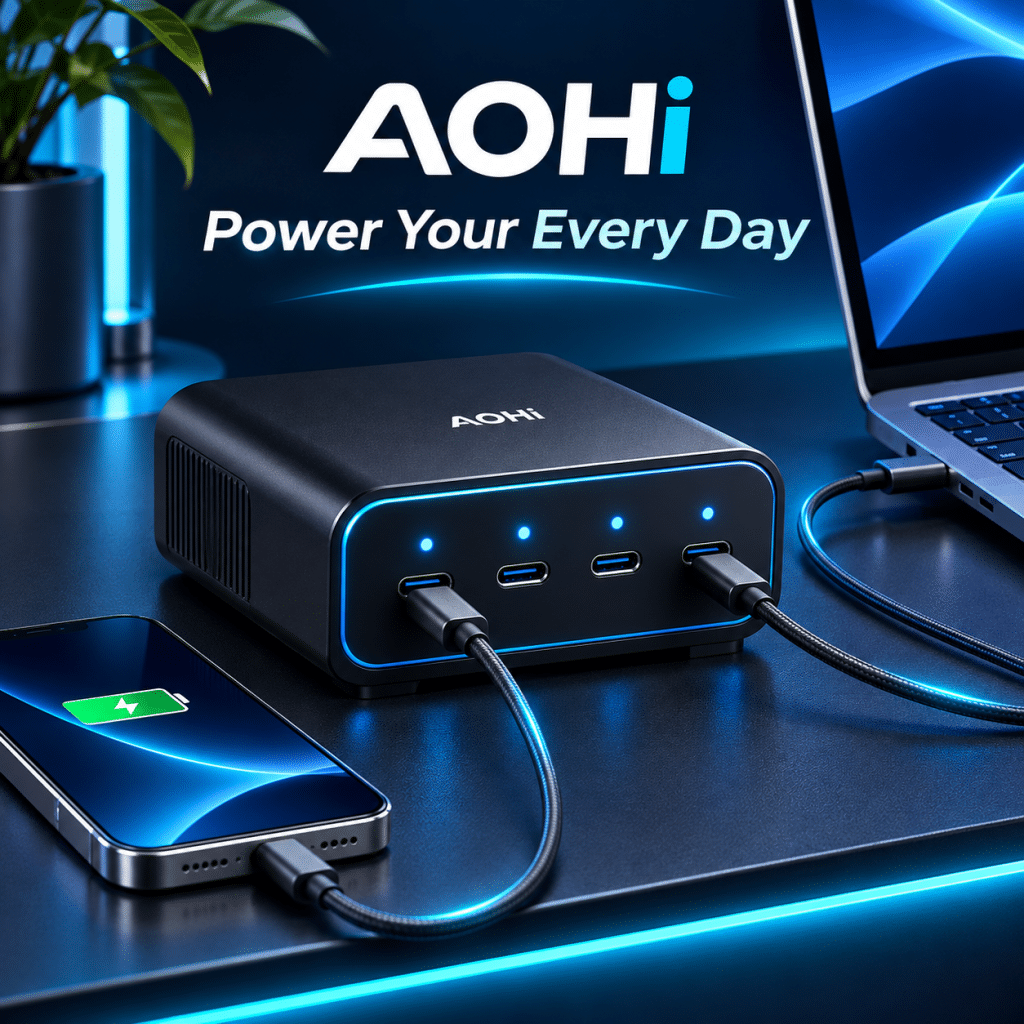
AOHI’s catalog is built around a practical question: what kind of power connection is needed in a particular setting? The company sells wall and desktop chargers, car chargers, power banks and cables, alongside cases and other accessories. Rather than centering its storefront on a single device, AOHI presents a collection of products with different output ratings, port counts and formats. Its official store, Iaohi, also groups selected products into bundles that pair charging equipment with cables or portable batteries.
That breadth makes AOHI more useful to understand as a charging-accessory company than as the maker of one flagship item. The listings provide a way to compare products by their stated specifications: a charger’s wattage and number of ports, a power bank’s stated capacity and output, or a cable’s advertised data and charging figures. Those labels are the starting point for navigating the range; they do not, by themselves, establish how a particular device will perform with every piece of connected equipment.
A catalog arranged around charging situations
The store separates products into recognizable categories, including GaN chargers, iPhone chargers, car chargers, EU-version chargers, power banks, charging stations and fast cables. The organization suggests several distinct contexts for choosing equipment: a compact adapter for a wall outlet, a multi-port unit for a desk, a charger intended for use in a vehicle, or a battery that can be carried away from a power source. The product names and category labels give shoppers a way to narrow the selection before comparing individual specifications.
AOHI’s range includes chargers at several listed power levels. For example, the storefront features The Youth PD 100W GaN 3-Port Fast Charger, The Youth 140W PD3.1 GaN 3-Port Fast Charger, Magcube Pro 140W GaN+ with two USB-C ports and one USB-A port, and The Future AI PD3.2 170W 3-Port LED Display Wall Charger. These are not interchangeable descriptions: the listed wattage, connector mix and named charging standard differ from one product to another. The site also lists a 280W, six-port desktop charging station, a higher-port-count option within the catalog.
Those distinctions matter when comparing listings. Someone considering a charger can first check how many ports it offers and which connector types are specified, then consider the stated total power rating and plug options. AOHI lists US, EU and UK plug options for some products, while the desktop station listing also names AU as an available version. The pages do not provide a single universal compatibility chart in the material available here, so a purchaser would need to consult the specific product details for the devices and regional plug format at issue.
Portable power, with capacity and output shown in the names
Power banks form another substantial part of the range. The storefront names models with capacities of 10,000mAh, 20,000mAh, 25,200mAh, 27,600mAh and 40,000mAh. It also uses output figures in several product names, including 140W, 170W, 210W, 240W and 310W. These figures help distinguish the products on the catalog page, but they describe different attributes: capacity and output should not be treated as the same measure. The pages list those values but do not give enough information to calculate a device-specific number of recharges or runtime.
Examples include the Starship 240W 27,600mAh LED Display Power Bank, the Starship 40,000mAh Power Bank with a 140W charger designation, the BLACK WARRIOR 25,200mAh 170W PD3.0 LED Display Power Bank, and the Starship Pro PD3.1 310W 20,000mAh LED Display Power Bank. Other listings describe a 10,000mAh Starship Pro with a 210W PD 3.1 label. The varied naming makes it especially important to read the complete listing rather than infer a product’s characteristics from a family name such as Starship or BLACK WARRIOR alone.
Several models include LED display language in their names, and the product listings also show power banks offered with a USB-C-to-USB-C cable. That establishes the presence of a display feature or a cable in the described listing, but the supplied pages do not explain exactly what information each display shows or the full cable specifications in every bundle. Those details are best confirmed on the individual product page. In a broad catalog, this kind of careful comparison is more reliable than assuming that products in the same family share every feature.
Cables are part of the product system
AOHI does not treat cables as an afterthought to its chargers and batteries. The catalog includes USB-C-to-USB-C options, a Magline PD3.2 240W nylon cable with an LED digital display, and the Adonis USB4 2.0 cable, which the store lists in 3.3-foot and 6.6-foot versions. The Adonis listings advertise 240W and include figures of up to 120Gbps and 8K in some product names. These are manufacturer-provided specifications; the source pages do not establish performance in every host-device combination or explain all conditions behind the figures.
A more unusual item is The Future PRO Creative Power Cable Set. The storefront describes it with a 240W rating, 8K and 40Gbps figures, and a length range from 0.33 to 8.53 feet. A separate description on the home page says the set uses mix-and-match cables to change the overall length. That gives the cable set a different role from a single fixed-length lead: the advertised design is built around adjusting the cable arrangement. The product page would still be the place to verify what components are included and which combinations suit a particular setup.
The listings also include a Prometheus 3-in-1 Titanium EDC PD 3.2 240W Tool Cable. Its name identifies it as a multi-purpose cable product and specifies a titanium construction, but the supplied source text does not explain the tool functions or provide operating instructions. It is therefore possible to note its place in AOHI’s cable range without making assumptions about how it should be used. Taken together, these examples show that the company’s cable category covers standard connections as well as products distinguished by length options, displays or bundled components.
Bundles connect products across categories
The bundles page brings chargers, power banks and cables together in named combinations. One listing pairs the 280W six-port desktop charging station with a 40,000mAh, 140W Starship power bank. Another combines the 170W three-port wall charger with an Adonis USB4 2.0 cable. Other sets put a Starship power bank, a 140W GaN+ PRO charger and an Adonis cable together. The bundle selection therefore provides a route to considering multiple parts of the catalog at once, rather than shopping for each category independently.
Bundles vary in their contents, and some offer more than one possible configuration or cable length, as indicated by “From” pricing on the collection page. The page also displays sale and regular-price figures for many listings. Because these are storefront prices and promotions can change, they should be checked on the current product listing rather than treated as fixed. The broader point is that a bundle’s usefulness depends on whether its included components match the intended setup; the presence of several products in one package is not, on its own, a compatibility guarantee.
For comparing a bundle, it helps to identify the components one by one: the charger’s wattage and port count, the battery’s stated capacity and output, and the cable’s length and specifications. AOHI’s product titles often surface those details, while the bundle page shows which items are paired. This can make the selection process more legible, but exact connector requirements and device compatibility should be checked against the full descriptions for the selected items.
Manufacturing and laboratory information
AOHI’s home page also shares company-level information about manufacturing and testing. The company says its seventh factory, a $100 million investment covering 34,000 square metres, was completed at the end of 2023. It describes the facility as using intelligent manufacturing systems and information technologies. This is the company’s account of its manufacturing development; the supplied pages do not provide independent detail about production volumes or how the facility relates to a particular product.
The same page describes an Indonesian factory of more than 35,000 square metres and says it has over 1,100 employees, several automated production lines and an MES system used to track product status. It states that the system enables real-time status control and 100% data tracking. These statements offer a view into how AOHI presents its production operations, but they should be understood as company-provided information rather than as a third-party audit of each product or manufacturing process.
AOHI also says its laboratory passed CNAS certification and that its data has been accepted by UL, TUV, IECEE and Intertek. The company describes the lab as covering 2,000 square metres and containing more than 400 testing machines. This is relevant context for understanding the company’s own account of its testing resources, but the source page does not identify specific test reports or connect a particular lab result to every product in the catalog. Product-specific certification or compliance questions therefore call for checking the corresponding item documentation.
How to read AOHI’s range
A useful way to approach AOHI’s storefront is to start with the form factor and then compare the details. Choose the broad category—wall charger, desktop station, car charger, power bank or cable—according to the type of accessory being sought. Within that category, use the named wattage, port count, battery capacity, length and connector information to distinguish listings. If a product name includes a protocol designation such as PD3.1 or PD3.2, treat it as a specification to verify against the device and accessory documentation, not as a substitute for checking compatibility.
AOHI’s site presents an extensive assortment rather than a single product story. Its chargers range from three-port wall adapters to a six-port desktop station; its power banks span multiple stated capacities and output figures; and its cables include fixed lengths, adjustable configurations and display-equipped models. Bundles link those categories for shoppers considering a combined setup. The product pages and the company’s manufacturing information provide the clearest supported picture of the brand: a broad charging-accessory business whose catalog is organized around the stated features of each charger, battery and cable.
Sponsored by Gabal Global Group, with publishing tools from CheapPlugins.