


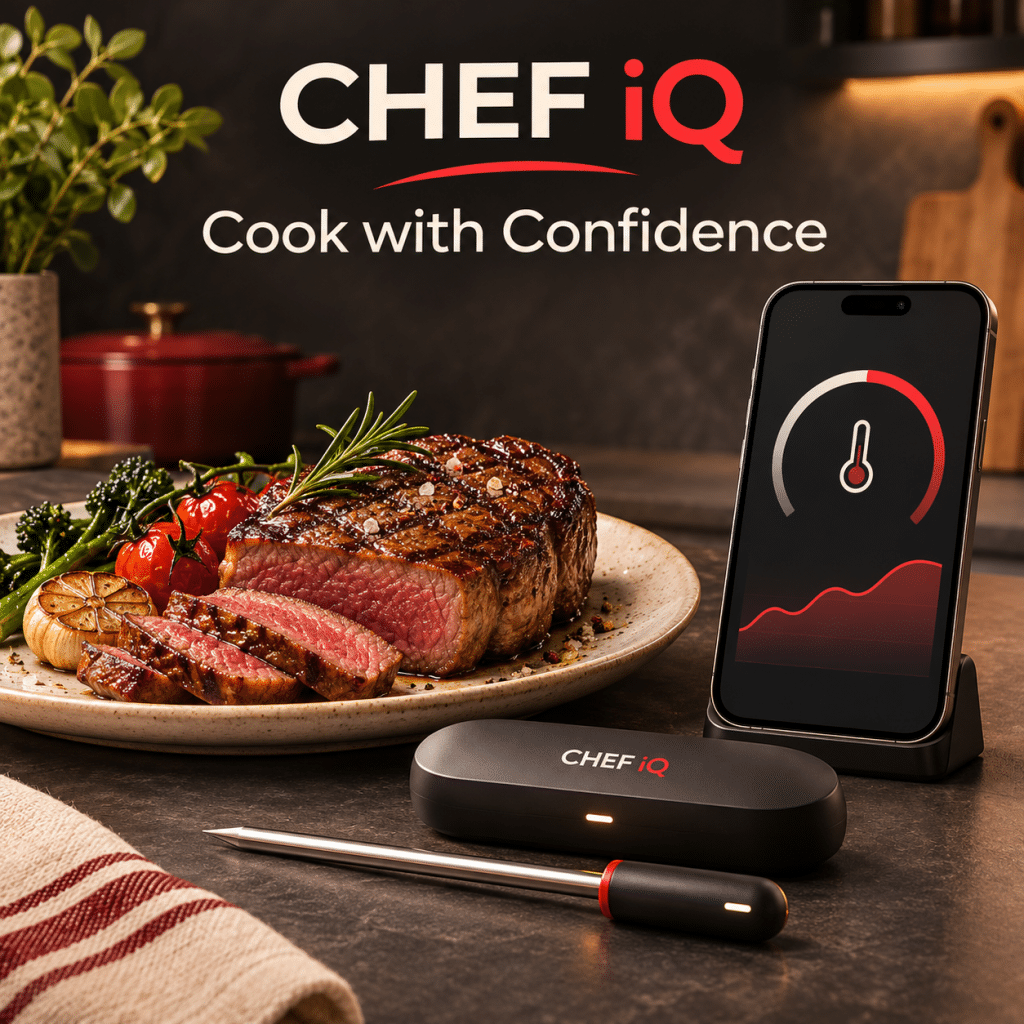
CHEF iQ presents itself as a home-cooking company built around helping people explore more in the kitchen. Its website brings together appliances, a cooking app, and connected accessories under that idea, rather than focusing on one signature device. The clearest way to understand the brand is to look at how its products address different parts of a cooking session: choosing a method, following guidance, monitoring progress, and repeating a meal. Chefiq describes this connected approach through products including the iQ Sense wireless thermometer, the iQ MiniOven, and the iQ Cooker multicooker.
Those products do not all serve the same purpose. The iQ MiniOven is a countertop appliance with multiple cooking functions, while iQ Sense is a temperature probe designed to relay cooking information through a Smart Hub and the CHEF iQ App. The home page also features the iQ Cooker, and describes its app as part of the brand’s broader cooking experience. Taken together, the pages depict CHEF iQ as a company connecting cooking equipment with software and practical guidance, while leaving each device with its own specific role.
A cooking system made up of distinct tools
The company’s website emphasizes that its products can work as individual appliances as well as parts of a connected setup. The iQ MiniOven, for example, can operate without additional peripherals. Its FAQ says users do not need the app to use the oven, though they do need to link it to a CHEF iQ account upon first use. The app adds remote monitoring and control, and the oven can pair with iQ Sense for temperature-based cooking. That distinction matters: the connected features extend the appliance, but the MiniOven is not presented as unusable without a separate thermometer.
iQ Sense has a more specialized job. It measures food and surrounding cooking conditions, then sends information to the Smart Hub, which relays data to a phone or tablet. The hub also charges the probe and provides audible alerts through its built-in speaker. CHEF iQ says the hub’s Wi-Fi connection supports monitoring from anywhere, while Bluetooth is also listed as a connectivity feature. The product page frames the combination as a way to keep track of cooking progress without staying beside the oven, grill, or other cooking surface.
This division of roles gives the brand a practical organizing principle. One device handles a range of cooking methods; another concentrates on temperature information. The MiniOven can use the thermometer’s readings when the two are paired, while the app offers controls, notifications, presets, and recipe guidance described across the product pages. The site does not suggest that every CHEF iQ product has identical features. Instead, it presents a family of tools whose functions overlap in selected ways.
The iQ MiniOven: a compact appliance with many modes
The iQ MiniOven is described as a 25-quart countertop oven with 11 cooking functions. Those functions are bake, roast, air fry, dehydrate, toast, slow cook, broil, air broil, reheat, keep warm, and proof. A Dual Cook setting can combine functions back to back, according to the product page. This range makes the oven more than a single-purpose toaster-style appliance, while its listed capacity provides a concrete sense of what can fit inside: the company says the interior accommodates a 13-inch pizza or a 9-by-13-inch baking tray.
CHEF iQ lists a temperature range of 70°F to 500°F and six heating elements, with four at the top and two at the bottom. The appliance also has a DC motor rated up to 3,200 RPM. The product page connects that motor and the maximum temperature with faster cooking and crispier food; those are the company’s stated benefits, rather than independent performance findings. Its interior is described as custom-lined stainless steel intended to improve heat reflectivity and retention. Other listed design details include a color touchscreen, natural-tone interior lighting, a viewing window, a soft-close door, a cool-touch handle, and a built-in speaker for alerts.
The included accessories help clarify the oven’s intended range. The listed package contains a mini glide rack, ceramic-coated baking tray, ceramic-coated MiniRounds tray, wire rack, and air fryer/dehydrator rack. The page notes that a pizza stone, muffin tray, and grill pans are not included and are sold separately. This is useful context for anyone comparing the appliance’s advertised functions with the equipment supplied in the box: the product supports multiple cooking methods, but the accessory list is specific and not every optional piece is part of the standard package.
Software is another part of the MiniOven’s proposition. CHEF iQ describes hundreds of cooking presets and a cooking history that lets users return to past meals. The app can monitor and control the oven remotely over Wi-Fi, and most cooking functions can be started remotely. The FAQ gives an important qualification: broil, air broil, and toast sessions can be set up in the app but must be started at the oven itself. Remote starts also require the door to be closed. These details make the feature description more precise than a general promise of remote operation.
iQ Sense: temperature information beyond the kitchen counter
The iQ Sense is a wireless cooking thermometer for meat and other foods. Its product page lists four internal temperature sensors and one ambient sensor, with internal readings specified from 32°F to 212°F and ambient readings from 32°F to 1,000°F. CHEF iQ states that the internal measurements are accurate within 1°F and says the probe self-calibrates with each temperature measurement. The probe is made from stainless steel and zirconia, measures 0.19 inches thick and 4.75 inches long, and is described as waterproof and dishwasher safe.
Heat tolerance is a prominent part of the product’s positioning. The company says the probe is heat resistant up to 1,000°F and lists compatibility with ovens, stovetops, gas and charcoal grills, smokers, air fryers, deep fryers, and sous vide cooking. The range of settings is significant because a thermometer designed only for one cooking method would offer a narrower role. CHEF iQ’s page presents iQ Sense as a probe that can move among several environments, while the ambient sensor tracks the conditions around the food as well as the food’s internal temperature.
The Smart Hub is central to the remote-monitoring setup. It charges the probe, uses Wi-Fi as a base station, relays readings to a smart device or tablet, and plays audio notifications. The product page lists USB-C charging for the hub and multiple days of probe battery life per charge; elsewhere on the page it specifies more than 70 hours. The package includes a wireless probe, Smart Hub, and USB-C charging cable. A charging brick is not included, and both the probe and hub contain permanent rechargeable lithium batteries, according to the FAQ.
Through the app, CHEF iQ says users can receive real-time temperature updates, estimated finish times, flip reminders, and rest timers. The page also describes hundreds of chef-tested presets and video-guided recipes. These features make the thermometer more than a display of current temperature: the company’s stated design is to combine measurements with prompts and estimates. Those estimates and alerts are guidance, however, not a substitute for understanding the cooking task or checking the food as needed.
The app as a layer of guidance
The CHEF iQ App appears across the brand’s product descriptions as a shared place for instructions and cooking information. For iQ Sense, the page highlights presets, video guides, notifications, and temperature data. For the MiniOven, it lists remote control, remote monitoring, presets, and a record of cooking history. The home page also presents the app as a way to access cooking help. The specific tools vary by device, but the overall pattern is consistent: CHEF iQ pairs physical equipment with information that can guide or track a cooking session.
That software layer may be especially relevant to people who want repeatable instructions rather than a bare set of controls. Presets and guided recipes can offer a starting point, and cooking history can make a previous oven session easier to revisit. At the same time, the source pages do not claim that all recipes or presets are available on every product, nor that app guidance removes the need to make choices. The product descriptions are clearest when treated as device-specific: the thermometer’s app experience centers on temperature and timing, while the MiniOven’s centers on cooking modes, presets, and appliance control.
What the brand’s product range communicates
CHEF iQ’s official pages make a case for connected home cooking through a combination of versatility and feedback. The MiniOven bundles several cooking modes into a countertop appliance, with an app that can support setup and monitoring. iQ Sense focuses on temperature readings and remote alerts across a broad list of cooking environments. The iQ Cooker appears as another part of the range, though the supplied home-page material offers less technical detail about it than the dedicated MiniOven and thermometer pages.
For a shopper or home cook trying to understand the company, the useful distinction is between the hardware’s core task and the optional digital layer around it. The MiniOven supplies the cooking chamber and its functions; the app provides controls and cooking information. iQ Sense supplies probe measurements; the hub and app make those readings available away from the probe itself. Pairing is available between the thermometer and MiniOven, but the MiniOven’s FAQ also makes clear that it can work without extra equipment.
In short, CHEF iQ is not represented on its website by one product alone. Its identity is presented through a connected collection of cooking appliances and tools, with an emphasis on helping users monitor, manage, and repeat cooking tasks. The most detailed source material highlights the contrast between an all-purpose countertop oven and a dedicated wireless thermometer. Together, they show how the company applies its app-based approach to two different needs: choosing and controlling a cooking method, and keeping track of temperature while food cooks.
Sponsored by Gabal Global Group, with publishing tools from CheapPlugins.