


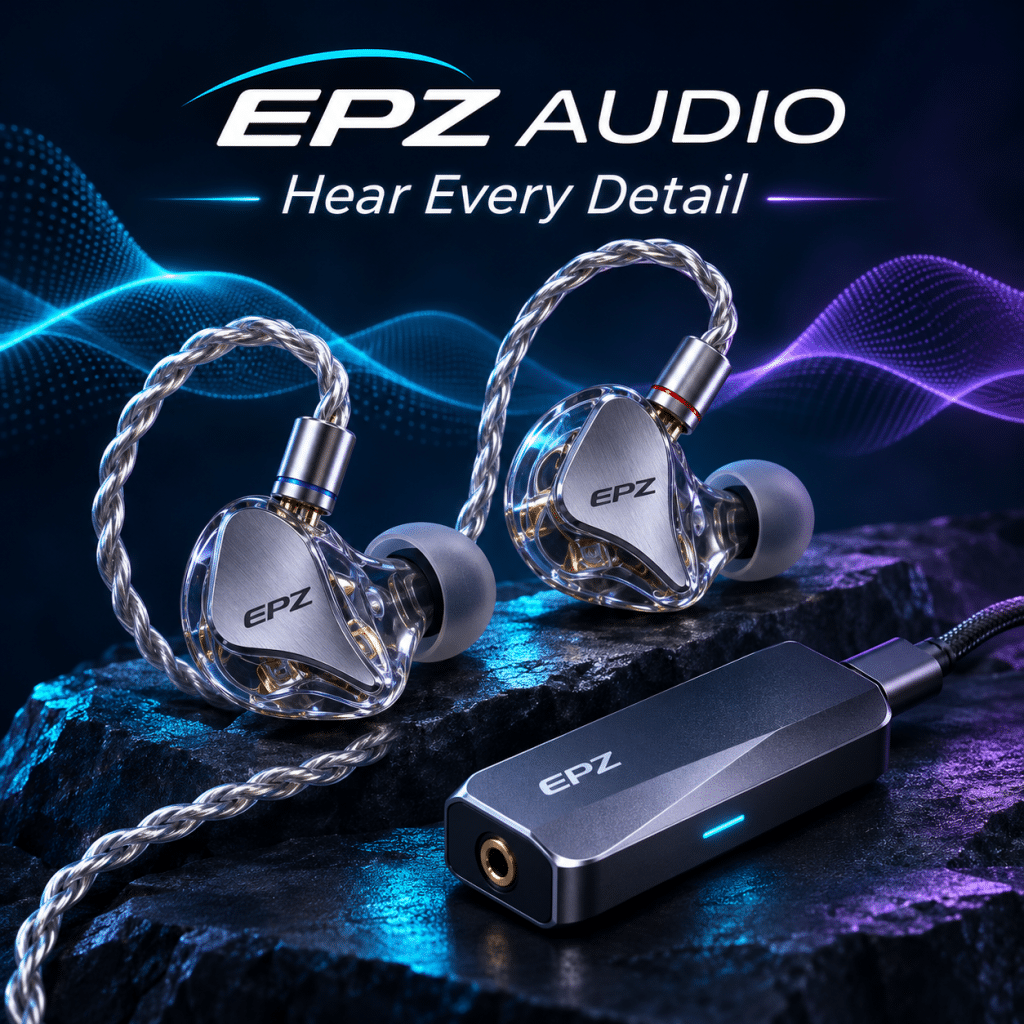
EPZ Audio is an audio company whose official store brings together wired in-ear monitors for music, gaming IEMs for play and voice chat, and portable DACs and accessories. Rather than centering on a single device, its lineup is organized around different listening contexts and a range of driver designs and connection options. The company’s account of its development process is also part of the picture: EPZ says it keeps acoustic development, shell production, tuning and final quality control closely connected. Explore the range and the company’s stated approach at Epzaudio.
That combination makes EPZ useful to consider as a maker of a broader audio lineup, not just as a storefront for individual earphones. Its pages distinguish between music-oriented IEMs and gaming models, while the accessories section adds DACs and other parts for a listening setup. The site also describes in-house work on 3D printing and resin materials for IEM shells. Those are the company’s own descriptions, rather than independent assessments of performance or production results.
A lineup divided by listening purpose
EPZ’s Hi-Fi IEM section is framed for music listening. The company describes its wired earphones as offering different tunings and driver designs to suit varying preferences and budgets. The listed models include the EPZ 550, K9, P50, P40, K5 and Q5 Pro. The range runs from the Q5 Pro, listed at $65.99 on the supplied page, to the 550 at $519. The page’s point is not that every model sounds alike, but that shoppers can browse several designs within the same product category.
Some models receive more detail on the store’s landing page. EPZ describes the 550 as using five balanced-armature drivers and a three-way crossover, with an emphasis on clarity, control and smooth extension. For the P40, the company lists a combination of two dynamic drivers, a planar driver and a PZT driver, calling it a tribrid arrangement. Its description associates that configuration with weight in the low frequencies, focused vocals and treble detail. These are manufacturer descriptions of intended sound characteristics; the pages supplied do not provide technical measurements or independent listening comparisons.
The gaming category addresses a different use case: game audio alongside voice communication. EPZ presents its wired gaming IEMs as alternatives to heavier headsets, and its category page identifies connection choices including 3.5mm and USB-C, as well as inline and boom microphone options across the range. Listed products include the G30, G20 Pro, G20, G10 Pro and G10. That variety gives the category a practical organizing principle: shoppers can compare models and connection or microphone formats against the equipment and communication setup they already use.
The G20 Pro is one example for which the homepage supplies additional specifications. EPZ lists a 10mm composite driver, esports-tuned digital signal processing, dual microphones and a stated fit weight of 3.9 grams. The company associates the model with positional game audio. The source does not explain the DSP settings, microphone arrangement or how the weight is measured, so these details are best read as a concise product description rather than a complete technical evaluation.
More than earphones: DACs and accessories
EPZ also sells portable digital-to-analog converters and amplifiers, which the store groups separately from its IEMs. The homepage names the TP65 Portable DAC, TP35 Pro Portable DAC, TS01 Gaming DAC and TP15 Portable DAC Dongle. The listed prices on that page range from $14.99 for the TP15 to $129 for the TP65. The supplied material identifies these as portable or gaming DAC products, but does not give detailed specifications such as supported formats, output power or device compatibility. Those are important details for a buyer to check on the relevant product page before selecting a model.
The accessory category also includes M100 liquid silicone eartips. Their presence reflects another part of the company’s catalog: the listening setup is not limited to the earphones themselves. However, the source material does not state sizes, fit guidance or compatibility information for the tips, and it would be unhelpful to infer those specifics from the name alone.
Viewed together, the categories show how EPZ presents its business: a customer may arrive looking for music IEMs, gaming earphones or a small DAC, and browse the adjacent parts of the catalog from the same store. This is a description of the store’s structure, not a claim that every product works together or suits every device. The pages provided do not establish universal compatibility, so connection type and intended use remain relevant checks for anyone comparing products.
The company’s stated approach to making IEMs
EPZ’s homepage places manufacturing and development alongside product browsing. The company says it keeps acoustic development, shell production, tuning and final quality control closely connected, and that feedback from listeners and partners informs the process. This description suggests that EPZ presents product development as a coordinated effort rather than separating acoustic work from the physical shell and final checks. The page does not detail the exact stages, testing criteria or how feedback changes a particular model, so those aspects should not be assumed.
The company also says it develops its own DLP 3D printers and resin materials for shell production, with the stated aim of maintaining consistent shell structures at scale. EPZ links high-precision internal structures to stability in the acoustic system and consistency between left and right channels. These are claims about the purpose of its production methods, as expressed by the brand. The supplied pages do not include measurements or independent verification of the results.
Customization is another element of the company’s description. EPZ says bespoke options can support custom colors and fit when needed, and its store includes a bespoke IEM category. The source material does not explain the ordering process, the range of available options, fitting requirements, lead times or terms. Readers interested in a custom configuration would need to consult the company’s current bespoke information for those practical details rather than assume that every model can be altered in the same way.
The Hi-Fi category page also describes its products as custom HiFi and studio IEMs and refers to medical-grade resin. That is wording supplied by the company; the pages do not identify a certification or provide further technical documentation about the material. It is therefore more precise to treat the phrase as EPZ’s description of its offering, not as evidence of a particular regulatory approval.
How to read the range
For someone navigating EPZ’s catalog, the clearest first distinction is the intended task. The Hi-Fi section is organized around music listening and variations in tuning and driver design. The gaming section is organized around game audio and communication, with multiple connection and microphone formats. DACs and accessories sit alongside those categories for shoppers looking at other components in a portable setup. This structure helps make sense of a catalog that spans several product types without implying that one category is a substitute for another.
The second distinction is how much product detail is available on the pages. The homepage gives headline descriptions of selected models, such as the 550, P40 and G20 Pro, while the category pages provide the broader list. A brief driver or feature summary can help identify what a manufacturer wants to emphasize, but it does not answer every question about sound, comfort, device support or use in a particular environment. The supplied material, for example, does not provide comparative measurements across the IEM range or detailed compatibility tables for the DACs.
EPZ’s store presents a sizable set of named products, but the company-level story is its attempt to connect that product range with its own development and shell-making work. It describes a process involving acoustic design, production, tuning, quality control and feedback, and points to its DLP printing and resin work as part of shell consistency. The specific products then illustrate the different directions of the catalog: multi-driver configurations in music IEMs, gaming-focused features in models such as the G20 Pro, and separate portable DAC options.
For readers comparing brands, that is a grounded way to understand EPZ Audio without treating its marketing language as proof of performance. The store provides a map of the company’s categories and selected design details, while its manufacturing statements explain how EPZ wants shoppers to understand its role as a maker. Product-level questions that the supplied pages leave open—such as detailed specifications, fit options, and connection compatibility—call for model-specific information. The company’s broader identity, meanwhile, is clear: EPZ is presenting itself as a supplier of music and gaming IEMs, related portable audio equipment and customizable shell options, with development and production described as closely linked parts of its work.
Get all details about Epzaudio
Sponsored by Gabal Global Group, with publishing tools from CheapPlugins.