


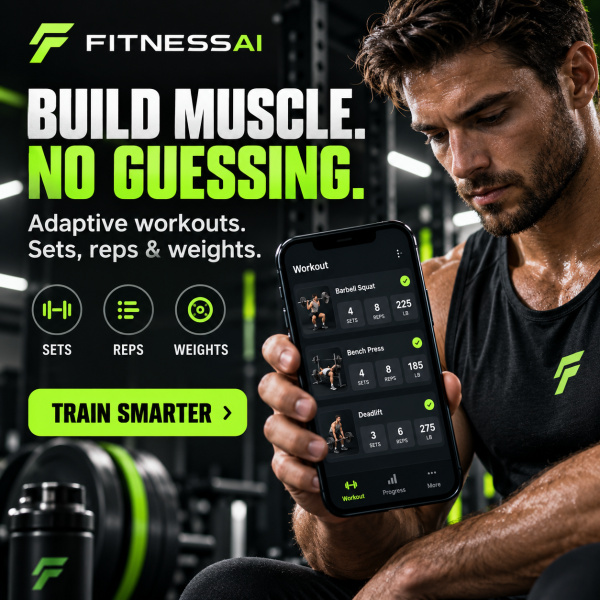
FitnessAI is a strength-training app built around a practical question: what should a person lift in the next session? Rather than asking users to choose every exercise, set, and weight themselves, the service says its artificial-intelligence system programs workouts and adapts them as training progresses. The company’s site presents the app as a way to structure resistance training for muscle growth and fat loss, with Fitnessai supplying the workout plan, tracking tools, and exercise guidance.
The defining idea is adaptive programming. FitnessAI says its recommendations draw on a large body of training data and use a person’s performance to adjust future work. The aim, as the company describes it, is to make progression more deliberate: users receive suggested sets, repetitions, and weights, then the program responds to how the training goes. The site also emphasizes that sessions can be changed to fit the time available and the equipment at hand.
A program that responds to performance
FitnessAI frames its approach around progressive overload: increasing training demands over time in a way intended to support continued strength and muscle development. Its page says the app can adjust weights and repetitions as a user improves, and can change intensity when performance indicates that the person should push harder or ease back. In this model, progression is not simply a fixed instruction to add weight at every workout. The system is presented as responsive to the training information it receives.
The app’s basic promise is to answer several routine programming questions in advance. It specifies which exercises to do, how many sets and repetitions to complete, and what weight to use. That can give a workout a clear structure before a user starts, instead of leaving each decision to be made between sets. FitnessAI describes this as reducing guesswork, while its performance-tracking tools are intended to show how strength changes and how the program adjusts.
The source page does not explain the algorithm’s exact calculations, the criteria behind each adjustment, or how it handles every kind of training history. It does, however, present the system as being informed by a substantial volume of training data. The company says its performance intelligence draws on more than 100 million sets, six million workouts, and 100,000 people. Elsewhere, it cites more than 100 million smart workouts completed and says its plans are built from millions of real training sessions. These are figures supplied by FitnessAI; the page does not provide further methodology for interpreting them.
Sessions designed around time and equipment
FitnessAI advertises workouts lasting from five to 30 minutes. That range positions the app for sessions of varying length, rather than requiring every workout to follow one fixed duration. The company says plans can adapt to a user’s schedule, although the page does not spell out exactly how a short session differs from a longer one or which exercises are prioritized when time is limited.
Equipment flexibility is another central feature. FitnessAI says workouts adjust to what a person has available, whether that is equipment at a gym, at home, or while travelling. It also describes exercise swaps that can be made when the planned equipment is unavailable. This makes equipment choice part of the programming concept: a changed setting need not mean abandoning the session, because the app is designed to offer an alternative exercise that fits the available setup.
The page does not provide a complete equipment catalogue or specify which substitutions are available for each movement. Its supported point is broader: the workout is intended to adapt to changing equipment access. For someone moving between locations or training with different resources, that flexibility is presented as a way to keep a structured plan in place without assuming access to one particular gym setup.
Time and equipment adaptations work alongside the app’s prescribed sets, repetitions, and weights. In effect, FitnessAI presents the workout not as a static list, but as a plan that can change in response to practical constraints as well as training performance. The site says the app adjusts automatically, though it does not detail every step a user takes to set up a session or confirm an equipment change.
Guidance during the workout
FitnessAI also includes exercise demonstrations. Its site describes guided videos and muscle visuals intended to help users understand how to perform movements and which muscles are involved. The company characterizes these tools as form guidance for each rep and set. They complement the programming features: the app is not only intended to select exercises and loading, but also to provide visual reference while a person performs them.
The page does not claim that a video or muscle illustration replaces individualized coaching, nor does it provide detail about the demonstrations’ coverage across all exercises. What it does support is that guided exercise visuals are part of the app’s offering, alongside recommendations for sets, reps, and weight. The combination is aimed at making a session easier to follow, especially for users who want an on-screen reference as they move through the planned exercises.
FitnessAI further says that users can track strength gains and see how the algorithm changes their program. That visibility is significant to the way the company describes the service: recommendations are meant to be paired with records of training, so users can follow a progression rather than receive an unexplained sequence of workouts. The page does not specify all the statistics available in the tracking interface, but it identifies strength tracking as a core part of understanding progress.
Recovery, wearables, and body-composition tracking
The service describes an adaptive-recovery feature that monitors performance and adjusts intensity when it determines a user should back off or push harder. This is presented as another part of responsive programming, distinct from simply increasing weights as strength improves. FitnessAI’s page does not explain what signals are used to assess recovery or how the system distinguishes temporary difficulty from a reason to reduce intensity, so those details should not be assumed from the feature description alone.
FitnessAI also advertises Apple Watch integration, saying performance can be synchronized automatically to support accurate training data. The site does not list the precise information transferred or describe compatibility requirements. Its stated role is to connect wearable information with the app’s training record, fitting the broader emphasis on using performance data to guide workout adjustments.
For body-composition tracking, the company promotes a 3D BodyScan visualization intended to show muscle gain and fat loss beyond what a scale alone indicates. The page positions this as a way to view changes in body composition, rather than relying only on body weight. It does not explain the scanning process, what equipment or measurements are required, or how the visualization is calculated. The supported description is that the app offers this visualization as a progress-tracking feature.
Challenges and the service’s stated scale
Alongside individual workout programming, FitnessAI lists structured challenges focused on muscle growth, lean results, and consistency. The company says rewards are on the line, but its page does not explain the challenge rules, reward details, eligibility, or timing. The feature is presented as an additional way to give training a defined focus, rather than as a substitute for the app’s adaptive workout plan.
The website uses several audience and usage figures to describe the service’s reach. It states that the app has more than five million downloads, refers to 500,000-plus active users, and displays a 4.8-star rating. It also presents user comments describing adaptive weight recommendations, time-conscious sessions, and an interest in seeing how programming decisions are made. These are figures and quotations published on FitnessAI’s own page, not independently established measures in the material available here.
Taken together, FitnessAI’s stated features form a connected training system: the app recommends exercises and loading, changes the plan in response to performance, offers alternatives for different equipment, and records information intended to make progress visible. Exercise demonstrations support the workout in the moment; wearable integration and recovery adjustments are described as ways to inform the training record and its intensity; and body-composition visuals and challenges extend the tracking and motivation elements.
That design makes FitnessAI more specific than a general exercise library. Its central proposition is that a user can follow a programmed strength session without independently working out every set, repetition, and weight, while retaining some flexibility around schedule and equipment. The company’s description is clearest about those functions and less detailed about the underlying algorithm, the exact data inputs, or the mechanics of individual features. For readers assessing the app, that distinction helps separate the listed capabilities from unanswered implementation details.
FitnessAI’s own framing is straightforward: provide a plan, update it as training changes, and make the resulting progression easier to follow. Whether a person is interested in shorter sessions, equipment substitutions, visual movement guidance, or data-linked progression, those are the areas the company highlights. The app’s identity rests on combining them in one adaptive strength-training program rather than treating workout selection, tracking, and progression as unrelated tasks.
Get all details about Fitnessai
Sponsored by Gabal Global Group, with publishing tools from CheapPlugins.