


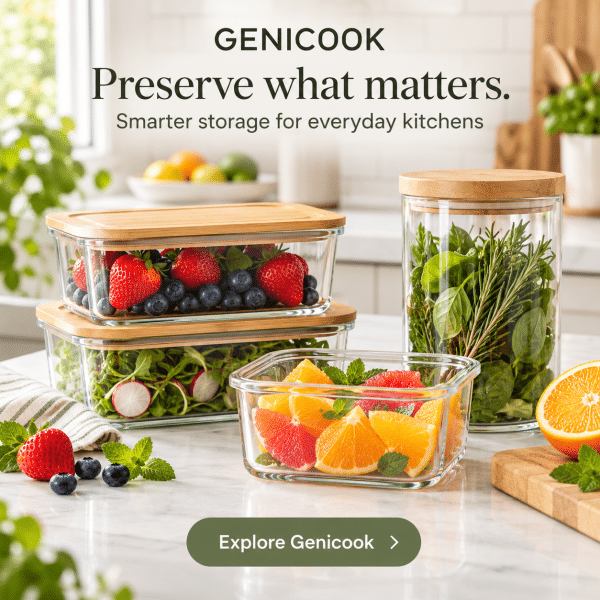
Kitchenware often has to serve more than one moment in a meal: ingredients are measured and prepared, food is cooked, and leftovers need a place afterward. Genicook builds its range around that broader routine, offering storage in several materials alongside measuring tools, bowls, cookware and other kitchen essentials. Its stated aim is to make practical, thoughtfully designed pieces for everyday kitchens. Genicook presents the brand as a company focused on making cooking, storing and sharing food feel more manageable.
That range gives Genicook a wider identity than a single-container or cookware specialist. Its catalog includes glass and stainless steel storage, refrigerator-oriented products, meal-prep tools and a separate group of vacuum-sealing products under the VaultFresh name. The company’s own story emphasizes manufacturing and product assembly, while its collection shows how it translates that focus into different materials and tasks. Looking at the brand through those connected parts helps explain what it offers without reducing it to one featured item.
A brand developed around manufacturing and everyday use
Genicook traces its roots to a parent company established in 2008. According to the company’s account, that business supplied the foundation for the later brand through its manufacturing capabilities, experience and emphasis on craftsmanship. Genicook itself took a more visible form in 2017, when it opened its first brick-and-mortar store in Dallas and began making products available through multiple online platforms. The timeline describes a gradual development from a manufacturing base to a consumer-facing kitchenware brand.
The company says its approach to food storage centers on reliability, safety and long-term use. It identifies borosilicate glass as a material used in its products and says items are assembled under its own quality-control standards, with attention to consistent fit, durability and performance. These are descriptions of the company’s design and production priorities, rather than a guarantee that every product in the wider catalog shares the same material or construction. Its listings show that Genicook works with multiple materials, including glass, stainless steel, silicone, stoneware and bamboo.
Genicook’s brand language also stresses accessibility: its stated mission is “Kitchenware for All,” with products intended for a range of home cooks, from beginners to more experienced cooks. The product selection supports that broad positioning. Alongside storage pieces are measuring cups, spatulas, glass bowls and sets designed for carrying or serving. Rather than concentrating only on cookware or only on preserving leftovers, the catalog reaches across familiar kitchen jobs.
Storage choices shaped by material and routine
Food storage is a prominent part of the collection, but the range is not limited to one format. Genicook lists rectangular, square and round stainless steel containers, as well as glass containers with lids in round and rectangular shapes. Other listings include tinted container sets, mini glass containers, stoneware containers and jars with bamboo lids. This variety gives shoppers different forms and materials to consider, though the available source material does not specify that every container has interchangeable parts or identical care requirements.
The company’s product descriptions offer a few more specific examples. Its medium mason jar set is described as borosilicate glass with metal lids and compatibility with vacuum sealers for airtight storage. A separate flip-over pickle jar uses a liquid-separating design intended to make serving less messy, and is also described as borosilicate glass. These examples show how the brand applies design changes to particular storage tasks: one jar is presented for vacuum-compatible storage, while another is built around separating pickling liquid from the food being served.
Genicook also groups products around meal preparation and organization. Its listings include refrigerator storage, meal-prep tools, a colander container set with glass lids, and a glass grater that also serves as a salad bowl. The website describes its broader selection as supporting fresher food, easier preparation and more efficient use of space. Those are the brand’s intended benefits; the source pages do not provide comparative testing or measurements to quantify them.
Customization is another part of the assortment. The shop describes a do-it-yourself option for creating a container set by selecting colors, patterns and text. That feature sits alongside ready-made products in different colors and styles, including tinted round and rectangular container sets. In this way, the catalog presents storage not only as a functional category but also as something customers can personalize visually. The pages do not detail the full range of customization choices or how each design is produced.
Tools for the steps before and after cooking
Genicook’s listings extend beyond containers into small tools for preparing ingredients. Measuring products include three-spout measuring cups, a measuring cup with a juicer and a glass measuring set. The three-spout design is named in the product title, but the source pages do not explain its particular pouring functions, so it is best understood simply as one of the brand’s measuring options. High-heat silicone spatulas are also listed, placing a heat-oriented utensil among the basic tools in the collection.
For mixing and serving, the brand offers sets such as the Rainbowl glass mixing set, an eight-piece mix-and-store-serve glass bowl set, and a stainless steel bowl set described for mixing and carrying. There is also a bake-and-carry glass set. These names suggest that several items are intended to span more than one stage of kitchen use, but the source pages do not provide detailed specifications for every set. The useful distinction is at the category level: the catalog includes pieces for preparation and serving as well as storage, rather than treating the refrigerator as the only destination for its products.
Smaller specialty items add character to the range. The website features hand-blown borosilicate glass pieces shaped as a cow creamer and a cow butter dish. It describes the creamer as having a playful artisan design and the butter dish cover as individually hand-blown from heat-resistant borosilicate glass, giving each one a distinct character. These products differ from the more utilitarian container sets, but they fit the company’s broader presentation of kitchenware as both functional and visually considered.
VaultFresh adds vacuum sealing to the brand
Genicook’s related sub-brand, VaultFresh, focuses on smart sealing products. The company says the range was created in response to the importance of keeping food fresh in busy households. Its pages describe a patented vacuum system operating at minus eight PSI and say that a single touch activates the process. The claimed aim is to slow oxidation and help preserve food’s freshness, flavor and quality for longer. These performance statements belong to the brand’s own product descriptions.
The listed VaultFresh equipment includes the [M]1 and [C]1 sealers, flat and tall vacuum sealers, vacuum lids, reusable bags, jars and containers. The [C]1 is described as a one-touch vacuum sealer for weekly preparation, leftovers and bulk storage, and the company says it works with its seal bags, mason jars and Blooming Containers. The [M]1 is presented for preservation as well as marinating; its one-touch Marinate Mode is described for use with Blooming Containers. The site says vacuum marination can produce results in 25 minutes that would otherwise take overnight, a specific claim that should be understood as the company’s own statement.
VaultFresh therefore adds a preservation method to Genicook’s broader storage offering, rather than replacing the company’s standard containers and kitchen tools. The product pages show vacuum-compatible options among jars and containers, while the sub-brand offers dedicated sealing devices and accessories. The sources do not establish that every Genicook storage product works with VaultFresh equipment, so compatibility should be checked for the specific item rather than assumed across the catalog.
A connected view of the kitchen
Across its collections, Genicook organizes its offer around a set of linked household tasks: measuring, mixing, preparing, storing, carrying and preserving food. The emphasis on different materials and formats lets the catalog serve varied uses, from a glass jar intended for vacuum sealing to a silicone spatula or a stainless steel container. Its company history gives context for that breadth, describing a brand that grew from a manufacturing foundation and later expanded into retail and online channels.
The most useful way to understand Genicook is as a kitchenware company with storage at its center and preparation tools around it. Its own descriptions emphasize craftsmanship, in-house manufacturing and quality control, while its product range brings together practical forms and some more decorative pieces. VaultFresh extends that approach into vacuum sealing through a distinct sub-brand and a set of compatible products identified by the company. Together, these details outline a brand built to address multiple parts of home food routines, while leaving product-specific materials, features and compatibility to be considered item by item.
Get all details about Genicook
Sponsored by Gabal Global Group, with publishing tools from CheapPlugins.